Coffee Altitude Grades: What SHB, SHG and HG Mean
Many Latin American coffees are graded by the altitude they grow at. Here is what Strictly Hard Bean, Strictly High Grown and the other grades mean, country by country, and why altitude matters in the cup.
Coffee altitude grades are the letters you see after many Latin American coffees: SHB, SHG, HB, HG. They describe how high the coffee was grown, because elevation is one of the best single predictors of how dense, sweet and acidic a coffee will be. This guide explains what each grade means, the elevation thresholds published for the main countries, what peer-reviewed research says about altitude and bean quality, and why the grades are a guide rather than a guarantee. It also explains why Jamaica Blue Mountain, one of the best-known high-grown coffees, does not use these letters at all.
What SHB and SHG mean
SHB (Strictly Hard Bean) and SHG (Strictly High Grown) are the top altitude grades in the countries that use them, and they mean essentially the same thing: coffee grown at the highest band of elevation recognized for export. "Hard bean" refers to the result: coffee grown higher and cooler ripens more slowly and produces a denser, harder seed. Countries tend to use one family of names or the other. Guatemala, Costa Rica and Peru use the "hard bean" names (SHB, HB), while El Salvador, Honduras and Nicaragua use the "high grown" names (SHG, HG).
Altitude grades by country
| Country | Top grade | Next grade(s) | Source |
|---|---|---|---|
| Guatemala | SHB: about 1,350 m (4,400 ft) and above | HB: about 1,200 to 1,350 m | Via Guatemala Coffee |
| Costa Rica | SHB: above 1,350 m | GHB (Good Hard Bean): 1,000 to 1,350 m; then HB and MHB | Cafe Imports |
| Peru | SHB: 1,350 m and above | HB: 1,200 to 1,350 m | Cafe Imports |
| El Salvador | SHG: 1,200 m and above | HG: 900 to 1,200 m; CS (Central Standard): 500 to 900 m | Cafe Imports |
| Honduras, Nicaragua | SHG | HG, CS | Cafe Imports (see our country guides) |
| Mexico | "Altura" (high grown); some sellers use SHG | Thresholds vary by seller | See our Mexico guide |
The thresholds are trade conventions, so different importers quote slightly different figures. Guatemala's system is one of the oldest: Barista Hustle's buyer's guide traces it to 1928, when coffee was divided into categories by elevation. Other countries, such as Colombia, Kenya and Jamaica, grade mainly by bean size (screen size) and defects instead; see green coffee beans for how screen grading works.
Why altitude changes the bean
Temperature falls as elevation rises, and in cooler conditions the coffee cherry ripens more slowly. The seed has longer to fill, which is generally linked to more sugars and acids and a denser bean. A 2024 study in Beverage Plant Research by Markos Makiso Urugo and colleagues at Jimma University measured green arabica from 20 agro-ecological zones in Ethiopia. Hundred-bean weight, moisture, fat, trigonelline and sucrose all rose with altitude, chlorogenic acid fell, and average temperature had the opposite effect. Rainfall showed no significant relationship, and caffeine was not tied to any of the environmental factors. The authors concluded that altitude and temperature were the more decisive factors.
Shade works in a similar way, by slowing ripening on lower, warmer farms (see shade-grown coffee).
Why the same altitude means different things in different places
What matters to the plant is temperature, not the number on an altimeter, and temperature at a given elevation depends on latitude. World Coffee Research's variety catalog reflects this by giving optimal altitudes by latitude band. For the Bourbon variety, for example, it recommends above 1,600 m within 5 degrees of the equator, above 1,300 m between 5 and 15 degrees, and above 1,000 m beyond 15 degrees. So a farm at 1,200 m in Central America (around 13 to 15 degrees north) can be "high grown" in a way that a farm at 1,200 m in Kenya, on the equator, is not. That is one reason a single altitude scale cannot be applied worldwide, and why comparing elevation figures between countries needs care.
What altitude grades do not tell you
- Quality is not guaranteed. An SHB coffee can still be badly picked, processed or stored. Grades usually also involve defect counts, but the altitude letters themselves only describe elevation.
- Grades are not always verified at farm level. They are export trade descriptions, and how closely elevation is checked varies by country.
- Higher is not always better for every variety. Some varieties and processing styles are chosen for lower farms, and very high farms face frost and slow growth.
- Roast can hide the difference. A very dark roast mutes the acidity and sweetness that altitude provides (see coffee roast levels). Cupping is the way buyers check what the altitude delivered (see how to cup coffee).
- Altitude is not origin protection. An SHB grade says nothing about whether a coffee sold under a famous name really came from that place; protected names are governed by their own origin rules (see coffee geographical indications).
How to read altitude on a coffee bag
- Look for the grade letters. SHB or SHG after a country name means the top altitude grade of that country's system, not a single worldwide standard.
- Convert units. Some bags give meters and some feet; 1,000 m is about 3,281 ft, and 1,350 m is about 4,430 ft.
- Prefer a range or a named farm. A specific farm or washing station with its own elevation tells you more than a national grade.
- Consider latitude. The same number means a cooler climate further from the equator, as explained above.
- Read it with the rest of the label. Processing, variety and roast date matter as much as elevation; see washed coffee and how to store coffee beans.
Altitude and Jamaica Blue Mountain
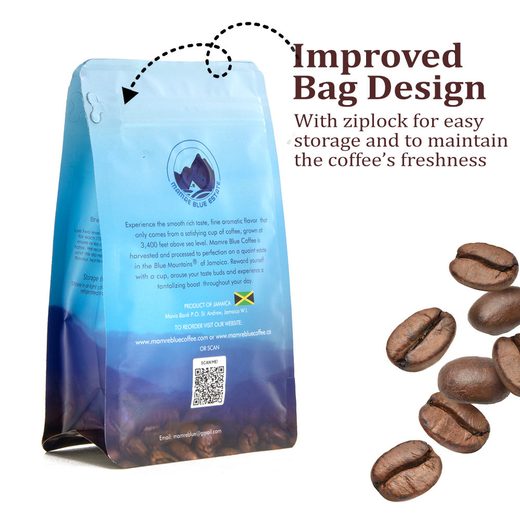
Jamaica does not use SHB or SHG. Under the JACRA Regulations 2018, Jamaica Blue Mountain is defined by a mapped area in the Blue Mountains, not by an elevation line, and it is graded by bean size and defects (see Blue Mountain coffee grades). Coffee grown elsewhere in Jamaica is sold under other names such as Jamaica High Mountain (see Jamaica High Mountain coffee). Elevations commonly quoted for Blue Mountain farms run from about 3,000 to 5,500 feet, a custom rather than a legal limit, and individual estates state their own; the bag above gives 3,400 feet. For comparison, the 1,350 m line used for SHB in Costa Rica and Peru is about 4,430 feet, inside that commonly quoted Blue Mountain range. Jamaica sits at about 18 degrees north, so by the latitude logic above, those elevations are cool for coffee, which helps explain the slow ripening behind Blue Mountain's mild, balanced cup (see the Blue Mountain growing area).
Disclosure: this site is published by Mamre Blue Coffee, a Jamaica Blue Mountain estate (see about us), so we rely on official and independent sources for the facts on this page.
Questions people ask
What does SHB mean on coffee?
What is the difference between SHB and SHG?
Does high-altitude coffee taste better?
Is Jamaica Blue Mountain graded by altitude?
Why do altitude thresholds differ between countries?
Sources
- Guatemalan Coffee Grades: SHB, HB, EP Explained (Via Guatemala Coffee)
- Costa Rica Coffee Origin Guide (Cafe Imports)
- Peru Coffee Origin Guide (Cafe Imports)
- El Salvador Coffee Origin Guide (Cafe Imports)
- Urugo et al., environmental factors and bean quality in Ethiopian Arabica coffee (Beverage Plant Research, 2024)
- World Coffee Research Variety Catalog: Bourbon
- The Jamaica Agricultural Commodities Regulatory Authority Regulations, 2018 (Jamaica Gazette)
- The Coffee Buyer's Guide to Guatemala (Barista Hustle)
Taste the benchmark


More in Coffee knowledge
- Coffee Auctions: Cup of Excellence and Best of PanamaCup of Excellence and Best of Panama score coffee through blind juries, then auction the winning lots online, often for record prices.
- Coffee Harvest Seasons: When Coffee Is Harvested by CountryCoffee is harvested somewhere in the world in every month of the year. Knowing when each origin picks, and when its coffee arrives, explains why some coffees appear only at certain times and what "new crop" means.
- Coffee Labels Explained: Organic, Fairtrade, Rainforest Alliance and OriginSustainability seals, organic labels and origin certification answer different questions. Knowing which question each one answers is the fastest way to read a coffee bag.
- Coffee Roast Levels: Light, Medium and Dark Roast ComparedRoast level changes a coffee more than almost any other step after harvest. This guide explains what light, medium and dark mean, how they change the cup, and what a 2024 study found about caffeine.
- Ethiopia's Coffee Trademarks: Harrar, Sidamo and YirgacheffeFrom 2004 Ethiopia registered Harrar, Sidamo and Yirgacheffe as trademarks abroad and licensed them royalty-free, a different route to protecting famous origin names than Jamaica or Colombia took.
- History of Jamaica Blue Mountain Coffee, from 1728 to JACRACoffee reached Jamaica in the 1720s; the Blue Mountain name became a regulated, certified product only in the 20th century, through the 1944 clearing house, the 1950 Coffee Industry Board and, since 2017, JACRA.
- How to Brew Jamaica Blue Mountain Coffee at HomeBrew Blue Mountain like any good washed arabica, but gently: fresh whole beans, about 1 to 2 tablespoons per 6 ounces of water, water just off the boil, and a grind matched to the method so that its mild, low-bitterness character is not over-extracted.
- How to Cup Coffee: A Step-by-Step Guide to Coffee CuppingCupping is how coffee is bought, graded and scored around the world. It looks like a ritual, but it is a simple, repeatable recipe that anyone can follow at home with a scale, a kettle and two spoons.