How to Brew Jamaica Blue Mountain Coffee at Home
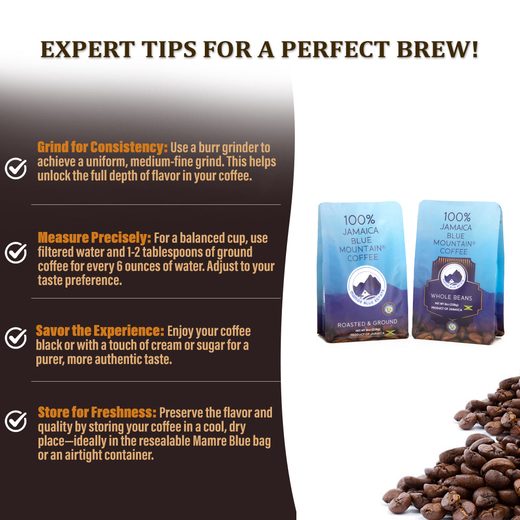
Brew Blue Mountain like any good washed arabica, but gently: fresh whole beans, about 1 to 2 tablespoons per 6 ounces of water, water just off the boil, and a grind matched to the method so that its mild, low-bitterness character is not over-extracted.
How do you brew Blue Mountain coffee? The short answer is the same way you would brew any good washed arabica, with a little more care not to over-extract it. Jamaica Blue Mountain is prized for being mild and low in bitterness, and the most common brewing mistakes, a grind that is too fine, water that is too hot or too long a contact time, add exactly the bitterness people are paying to avoid. This guide gives starting ratios and settings for the common home methods, using published guidance from the National Coffee Association rather than invented "secret" recipes.
Start with the right coffee
- Check it is 100% Blue Mountain. A "Blend" may contain as little as 30% Blue Mountain coffee by weight under Jamaica's 2018 regulations, and no brewing technique will make the other 70% taste like Blue Mountain. See the 30% blend rule.
- Prefer whole beans. The National Coffee Association recommends grinding as close as possible to brewing, and says whole beans give the freshest result.
- Look for a roast date. A mild coffee loses its character sooner than a dark one hides its age.
- Medium roast shows the origin best. Dark roasts are fine if you like them, but they replace much of what makes Blue Mountain distinctive with roast flavor. Our page on what Blue Mountain tastes like explains why.
The basic numbers
| Setting | Starting point | Source |
|---|---|---|
| Coffee to water (drip) | 1 to 2 tablespoons of ground coffee per 6 oz (about 180 ml) of water | National Coffee Association |
| Coffee to water (by weight) | About 55 g per litre, or about 13 g per 8 oz cup | The widely used Golden Cup guideline, as used in our price comparisons |
| Water temperature | 93 ± 3°C (about 195 to 205°F) | National Coffee Association (French press guide) |
| Water | Cold, filtered if possible; avoid distilled or softened water | National Coffee Association |
If you do not have a thermometer, let water come to the boil and rest for about 30 seconds before pouring. Weighing coffee with a kitchen scale is more consistent than tablespoons, because the volume of a spoonful changes with grind size.
Drip coffee maker
The National Coffee Association suggests a medium grind, "like kosher salt", and about five minutes of contact between coffee and water for a drip brewer. Use the upper end of the 1 to 2 tablespoon range if you take milk. If the coffee tastes bitter, try a slightly coarser grind; if it tastes flat or watery, go a little finer. Clean the machine regularly, because old coffee oils turn rancid and a mild coffee shows that quickly.
Pour-over (cone or dripper)
Pour-over is a good way to taste Blue Mountain because you control every variable. A practical starting recipe:
- Use about 15 g of coffee for 250 ml of water, ground medium-fine, a little finer than for a drip machine.
- Rinse the paper filter with hot water and discard the rinse water.
- Pour about twice the coffee's weight in water to wet the grounds and wait about 30 seconds while the coffee releases gas.
- Pour the rest slowly in circles over two to three minutes in total.
- Adjust next time: bitter or dry means grind coarser or pour faster; sour or thin means grind finer.
French press
The National Coffee Association gives a ratio of 1 gram of coffee to 10 to 16 grams of water, a coarse grind "like rock salt", water at 93 ± 3°C and about four minutes of contact. For a mild coffee, the middle of that ratio range, around 1:15, is a sensible start. Press gently and pour all the coffee off the grounds straight away, because it keeps extracting while it sits.
Pods and capsules
Pods trade some freshness for convenience, but sealed pods protect ground coffee from air better than an opened bag of ground coffee does. Choose the smallest cup size on the machine for a fuller cup, since larger settings simply push more water through the same small dose. As with bags, check the box says 100% Jamaica Blue Mountain rather than a blend.
Espresso and cold brew
Blue Mountain can be used for espresso, but its mildness means it produces a gentle shot rather than an intense one, and many people prefer to save it for filter methods. Cold brew mutes acidity and aroma further. Neither is wrong, but if you want to taste what makes the coffee distinctive, start with pour-over or a French press.
Milk, sugar and what to taste for
Try the first cup black. The traits Blue Mountain is known for, smoothness, balance and low bitterness, are easiest to notice without milk or sugar. After that, drink it however you enjoy it. If you are comparing it with another coffee, brew both with the same recipe so the method is not the difference you are tasting.
Storing your coffee
The National Coffee Association advises storing coffee in an opaque, airtight container in a cool, dark place, away from the stove and sunlight. Once opened, it suggests whole beans keep well for about one to three weeks at room temperature and ground coffee for one to two weeks. If you freeze beans, use a truly airtight container and take out no more than a week's worth at a time, returning the rest before condensation forms.
Common problems and fixes
- Bitter: grind coarser, shorten contact time, let the water cool slightly, or check that the coffee is not a dark-roast blend.
- Sour or thin: grind finer or use a little more coffee.
- Flat or papery: the coffee is probably stale. Buy smaller bags more often.
- Tastes like any other coffee: check the label for "100%" and see how to spot fake Blue Mountain coffee.
For background on where the coffee comes from and how it is certified, see Jamaica Blue Mountain coffee and Blue Mountain grades. Disclosure: this site is published by Mamre Blue Coffee (see about us); the brewing figures above come from the National Coffee Association, not from our own product claims.
Questions people ask
How much Blue Mountain coffee should I use per cup?
What grind is best for Blue Mountain coffee?
Should Blue Mountain coffee be brewed with boiling water?
Is Blue Mountain coffee good for espresso?
Sources
- Drip Coffee (National Coffee Association USA, About Coffee)
- French Press (National Coffee Association USA, About Coffee)
- Coffee Storage and Shelf Life (National Coffee Association USA, About Coffee)
- The Jamaica Agricultural Commodities Regulatory Authority Regulations, 2018 (Jamaica Gazette Supplement, March 2 2018)
- Jamaican Blue Mountain Coffee (Wikipedia)
Taste the benchmark


More in Coffee knowledge
- How to Spot Fake Jamaica Blue Mountain CoffeeJamaica's regulators have chased counterfeit Blue Mountain coffee for over a decade; buyers can screen out most of it by reading the label carefully and asking where the coffee came from.
- Italian Coffee CultureItalian coffee culture runs on the standing espresso bar and the stovetop moka pot, backed by more than a century of machine history and widely followed customs.
- JACRA: How Jamaica Certifies Blue Mountain CoffeeJACRA replaced the Coffee Industry Board in 2017 and now registers growers, licenses dealers and coffee works, certifies quality and holds export coffee in its own custody until it ships.
- Jamaica Blue Mountain Blend: What the 30% Rule MeansJamaica's 2018 regulations let a coffee be called a Jamaica Blue Mountain Blend if Blue Mountain coffee is at least 30% of its weight, up from 20% under the old 1953 rules.
- Jamaica Blue Mountain Coffee Grades: No. 1, No. 2, No. 3 and PeaberryBlue Mountain export coffee is sorted into size-and-defect classes, from No. 1 down to triage, with peaberry kept separate; a grade describes the beans, not the flavor or the authenticity of the bag.
- Japanese Coffee CultureJapan's coffee culture spans century-old kissaten cafes, vending-machine canned coffee, meticulous pour-over brewing, and a decades-long appetite for Jamaica Blue Mountain.
- The Coffee Belt: Where Coffee GrowsCoffee grows only within a tropical coffee belt, where altitude and climate, more than latitude alone, decide what grows where, and climate change is shifting the map.
- The Coffee Plant: How Coffee GrowsCoffee comes from the flowering shrub Coffea, whose cherries, genuine fruit despite the name bean, take three to seven years to reach a first harvest.