Guatemalan Coffee: Huehuetenango, Antigua and Beyond
Guatemala grades coffee by altitude across eight distinct regions, from volcanic Antigua to the high, dry, non-volcanic Huehuetenango highlands.
Guatemala grows coffee across eight officially recognized regions, each shaped by distinct soil, rainfall, and altitude, and grades much of its export coffee by elevation rather than variety alone. The result is one of the more internally diverse coffee-producing countries, spanning volcanic Antigua and the high, dry, non-volcanic Huehuetenango highlands near the Mexican border.
How many coffee regions does Guatemala have?
Guatemala's national coffee association, Anacafé, recognizes eight official growing regions: Antigua, Acatenango, Atitlán, Cobán, Fraijanes, Huehuetenango, San Marcos, and Nuevo Oriente. Each is treated as a distinct origin for marketing, quality competitions, and export promotion — roughly the way Napa and Sonoma are marketed as distinct regions within California wine, even though both are technically part of the same state and industry body.
Coffee is a relatively small footprint on the map — by one estimate it covers only about 2.5% of Guatemala's territory — but an outsized share of the country's agricultural export identity, thanks largely to that regional variety. Conditions differ sharply between and even within regions: altitude across the eight zones runs from roughly 1,300 to 2,000 m (4,300–6,600 ft), annual rainfall ranges from about 32 to 200 inches depending on the region, and the main harvest generally runs from November through April, with December to March the busiest stretch on most farms.
Antigua and Huehuetenango are the two names most often seen on specialty shelves, but Anacafé promotes coffee from all eight regions, and each has its own general elevation range and character. None of the eight is large in absolute terms compared with a bulk producer like Brazil; Guatemala's advantage has always been variety and quality density rather than sheer volume.
| Region | Typical elevation | Notable soil | General character |
|---|---|---|---|
| Antigua | 1,500–1,700 m (4,900–5,600 ft) | Volcanic | Full body, chocolate, spice, clean acidity |
| Acatenango | 1,300–2,000 m (4,300–6,600 ft) | Volcanic | Sweet, balanced, stone fruit and caramel |
| Atitlán | 1,500–1,700 m (4,900–5,600 ft) | Volcanic | Full body, citrus acidity, nutty |
| Fraijanes | 1,400–1,800 m (4,600–5,900 ft) | Volcanic | Bright acidity, aromatic, well-structured |
| San Marcos | 1,300–1,800 m (4,300–5,900 ft) | Volcanic | Floral, delicate acidity, sweet |
| Cobán | 1,300–1,500 m (4,300–4,900 ft) | Wetter, lower-lying | Balanced, mild acidity, soft fruit |
| Nuevo Oriente | 1,300–1,700 m (4,300–5,600 ft) | Non-volcanic, clay-rich | Full body, chocolate and toffee |
| Huehuetenango | Up to roughly 2,000 m (6,600 ft) | Non-volcanic | Bright, floral, wine-like |
What do SHB and HB mean on a bag of Guatemalan coffee?
Guatemala also grades much of its export coffee by growing altitude, independent of region. Strictly Hard Bean (SHB), the top tier, is generally defined as coffee grown at about 1,350 m (4,400 ft) or higher; Hard Bean (HB) covers roughly 1,200–1,350 m (3,900–4,400 ft). Lower grades, Extra Prime and Prime, step down through progressively lower elevations still, and are generally sold for everyday, non-specialty blends rather than marketed as single-origin coffee.
Altitude matters because coffee cherries ripen more slowly in cooler, high-elevation air, giving the bean more time to develop sugars and organic acids before harvest. Denser, slower-grown beans are generally associated with more concentrated sweetness and acidity, which is why SHB coffee commands a premium and why Guatemala's higher zones — Huehuetenango chief among them — are especially prized by specialty buyers.
What makes Antigua's volcanic soil different from Huehuetenango's?
Antigua sits in a valley ringed by three volcanoes — Agua, Fuego, and Acatenango — at roughly 1,500–1,700 m. Periodic ash fall from Fuego enriches the valley's soil with minerals, and the combination of volcanic soil, sunny days, and cool nights is closely associated with Antigua's classic profile: full body, dark chocolate, brown spice, and a clean, moderate acidity with a touch of smokiness.
Huehuetenango, in the far northwest near the Mexican border, is one of Guatemala's non-volcanic growing regions and its highest and driest, with coffee grown up to roughly 2,000 m (6,600 ft) — elevations that would risk frost almost anywhere else in the country. Warm, dry winds blowing off Mexico's Tehuantepec plains — the same coastal lowlands that separate Huehuetenango from Mexico's own coffee-growing states — protect the region from frost at that altitude. Without volcanic soil to draw on, Huehuetenango's character comes mainly from that extreme elevation and unusual microclimate, producing coffee that tends to be brighter and more floral or fruit-forward — citrus, peach, and wine-like notes are common descriptors — than Antigua's chocolatey depth.
What does Guatemalan coffee taste like?
Across its eight regions, Guatemalan coffee is generally described as medium to full-bodied with bright, sometimes wine-like acidity and a base of chocolate and caramel sweetness, though the specific balance shifts with region and elevation. Antigua, Acatenango, and Fraijanes tend toward chocolate, spice, and structured acidity; Huehuetenango, Atitlán, and San Marcos tend toward brighter, more floral or fruit-driven cups; Cobán, in a wetter, lower-lying zone, is often described as milder and softer. Nuevo Oriente, on non-volcanic clay soils, is typically described as full-bodied with chocolate and toffee notes rather than the brightness associated with the country's higher volcanic zones.
Roast level affects how much of this comes through in the cup — lighter roasts favor acidity, florals, and fruit, while medium and darker roasts push the chocolate and caramel notes forward and mute the brighter top notes. That range is one reason Guatemala shows up so often in both single-origin pour-over programs, where a lighter roast can highlight a specific region's character, and in blends, where a darker-roasted Guatemalan lot adds body and sweetness without much acidity to clash with other origins.
Because Guatemala grades so explicitly by altitude, buyers can use SHB and HB labels as a rough proxy for intensity: higher-grown lots tend to show more acidity and complexity, while lower-grown Extra Prime and Prime lots are typically softer and simpler, better suited to everyday drinking than to slow, single-origin tasting.
Guatemala's export coffee is grown almost entirely as arabica; unlike large-volume producers such as Brazil, which also grows substantial robusta, robusta plays essentially no role in Guatemala's coffee identity. That single-species focus, combined with the altitude grading system, is part of why so much of the country's output is marketed as specialty rather than commodity-grade coffee.
How does Guatemalan coffee compare with Jamaica Blue Mountain?
Guatemala's SHB grade — coffee grown at roughly 4,400 ft or higher — sits inside the elevation band commonly cited for Jamaica Blue Mountain, 3,000–5,500 ft, though that Blue Mountain figure describes custom rather than a legal minimum. Both countries lean on altitude as a marker of quality, but they organize it differently: Guatemala grades individual lots by measured elevation across eight named regions with real soil and climate differences, while Jamaica Blue Mountain is a single legally defined growing area — spanning the parishes of St Andrew, St Thomas, and Portland — treated as one origin regardless of exactly where within it a given lot was grown.
The two cups are also built differently. Jamaica Blue Mountain is widely described as mild and balanced with low bitterness, a gentler, more uniform profile than Guatemala is capable of as a whole, given how much Antigua's volcanic chocolate notes can differ from Huehuetenango's bright, floral cup grown in the very same country. Jamaica's regulator also enforces a rule that coffee labeled "Jamaica Blue Mountain Blend" must contain at least 30% actual Blue Mountain coffee, a legal floor that Guatemala's regional names do not carry.
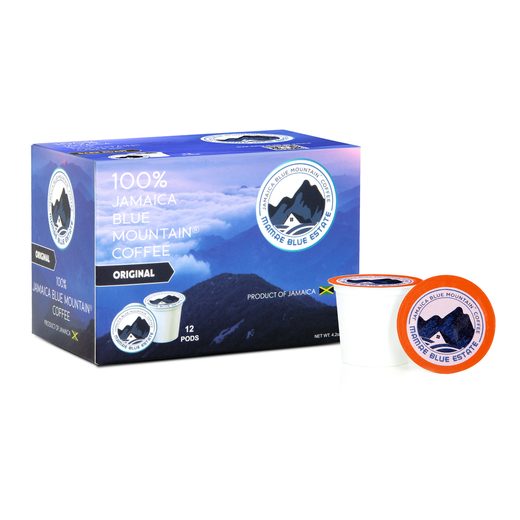
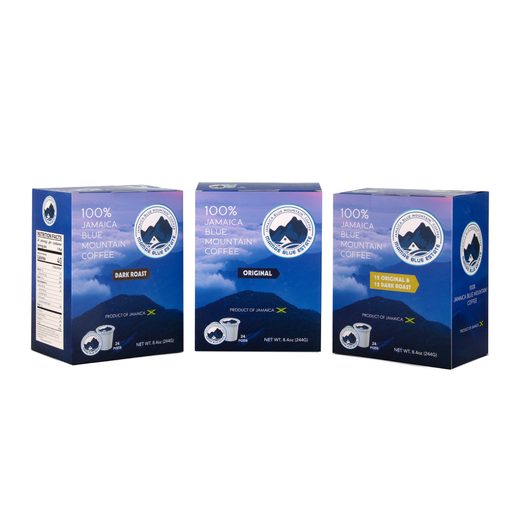
Both countries do share a mountainous, volcanically influenced growing story — Antigua's ash-enriched valley is not so different in principle from the way rich highland soil supports coffee elsewhere in the Caribbean and Central America — but Jamaica's tightly bounded single region gives it a level of consistency that a country as geographically varied as Guatemala cannot claim as a whole. Readers who want to taste the more tightly defined Blue Mountain benchmark alongside a regional Guatemalan coffee can start with Jamaica Blue Mountain whole bean, available alongside ground and pod formats in the shop.
Questions people ask
How many official coffee regions does Guatemala have?
What does SHB mean in Guatemalan coffee grading?
Is Antigua coffee grown on a volcano?
Why is Huehuetenango coffee different from other Guatemalan regions?
What does Guatemalan coffee taste like overall?
How does Guatemalan coffee compare with Jamaica Blue Mountain?
Sources
- Guatemalan Coffee Grades: SHB, HB, EP Explained — Via Guatemala Coffee
- Barista Guide: 8 Different Coffee Regions of Guatemala — Perfect Daily Grind
- Anacafé premia a productores de la Región Fraijanes en la Competencia de Café — Anacafé
- Guatemalan Coffee Guide | Antigua, Huehuetenango & 8 Regions — Moustache Coffee Club
- The Guide to Guatemalan Coffee Taste, Regions, and Quality — Refuge Coffee Roasters
Taste the benchmark
More in Origins
- Guji CoffeeA guide to Guji, one of Ethiopia's newest named coffee regions: its elevation, washed and natural processing, flavor, sales and how it compares with Jamaica Blue Mountain.
- Haitian CoffeeColonial Saint-Domingue once supplied some 60% of Europe's coffee; Haiti's industry today survives mainly as small-scale, family-farmed production for a niche export market.
- Harrar Coffee: Ethiopia's Dry-Processed ClassicA guide to Harrar, Ethiopia's classic dry-processed coffee region: its elevation, fruity wine-toned flavor, cooperative sales, harvest timing and how it compares with Jamaica Blue Mountain.
- Hawaiian Coffee Beyond Kona: Ka'u, Maui and KauaiKona isn't Hawaii's only coffee: Ka'u, Kauai and Maui grow roughly half the state's crop, now covered by a stricter 2024 labeling law.
- Honduran CoffeeHonduras is Central America's largest coffee producer, grading its washed, mostly smallholder crop by altitude across 15 departments.
- Huila Coffee: Colombia's Top Specialty RegionA guide to Huila, Colombia's top specialty coffee department: its elevation, varieties, flavor, sales, unusual harvest calendar and comparison with Jamaica Blue Mountain.
- Indian Coffee: Chikmagalur, Coorg and ArakuIndia grows both arabica and robusta under shade across Karnataka, Kerala and Tamil Nadu, from Chikmagalur's colonial-era estates to tribal-grown Araku Valley.
- Java Coffee: The Island, and Why Coffee Is Called JavaJava is both an Indonesian island and English slang for coffee, a legacy of three centuries as a top coffee source now centered on the Ijen Plateau's washed arabica.