Kenyan Coffee: AA Grades, SL28 and Bright Acidity
A guide to Kenya's grading system, key varieties and regions, with a fair comparison of its bright acidity to Jamaica Blue Mountain.
Kenyan coffee is graded by bean size — AA, AB, PB and C being the most familiar tiers — grown largely from the SL28 and SL34 varieties developed in the 1930s, and sold through the weekly Nairobi Coffee Exchange auction. It is best known for bright, wine-like acidity and blackcurrant-toned cups from high-altitude regions like Nyeri and Kirinyaga.
What do Kenya's coffee grades AA, AB, PB and C mean?
Kenyan coffee is sorted after milling by bean size, using screens measured in 64ths of an inch, on the premise that larger, denser beans tend to cup well — though grade is a size classification, not a direct quality score. According to trade sources including Trabocca and Royal Coffee:
- AA: the largest standard grade, beans retained by a screen size of 18 (having passed screen 17 or so as the lower bound); often the most sought-after size internationally, though not automatically the best-tasting lot in a given year.
- AB: a combined grade covering screen sizes 16 and 17, and by volume the most common grade Kenya produces; frequently praised by roasters for excellent quality despite its smaller average bean size than AA.
- PB (Peaberry): not a size class in the usual sense but a natural mutation, in which a cherry develops a single round bean instead of the usual two flat-sided beans. Peaberries are sorted separately and often marketed at a premium for their dense, concentrated cup.
- C: a smaller-screen grade below AB, generally considered a lower export tier than AA or AB, though still exportable.
Additional grades exist below and alongside these — including E (an oversized, elephant-bean grade), TT and T (lighter, wind-sifted or broken beans) and UG (ungraded, for the local market) — but AA, AB, PB and C are the grades most likely to appear on a US specialty bag. As with Colombia's Supremo and Excelso, size and quality correlate loosely rather than absolutely: a well-processed AB lot can outscore a mediocre AA lot in the cup.
What are SL28, SL34, Ruiru 11 and Batian?
Kenya's reputation rests heavily on a small set of named varieties, several traced to Scott Agricultural Laboratories' tree-selection work in the late 1930s.
- SL28: a single-tree selection from that era, still widely regarded by roasters as the variety most responsible for Kenya's blackcurrant-and-citrus reputation and prized in specialty markets, though it is susceptible to coffee leaf rust and coffee berry disease.
- SL34: selected from a single tree on the Loresho Estate in Kabete during the same research period; similarly well regarded for cup quality and, like SL28, vulnerable to the same major diseases.
- Ruiru 11: released in 1985 from the Ruiru research station, a compact, disease-resistant hybrid bred from Catimor lines crossed with SL28 and SL34; higher-yielding and hardier, though generally considered slightly behind the SL varieties in cup quality.
- Batian: released in 2010 by Kenya's Coffee Research Foundation, bred to resist both major coffee diseases while matching the SL varieties' cup quality — a newer option for farmers who want SL-level flavor with better disease resistance.
For a buyer, seeing "SL28" or "SL34" named on a Kenyan bag is a reasonable signal of traditional Kenyan character, while Ruiru 11 or Batian point to newer, hardier plantings that can still cup very well.
What is the Nairobi Coffee Exchange?
Most Kenyan coffee is sold through the Nairobi Coffee Exchange (NCE), a weekly auction — historically held on Tuesdays — where marketing agents bring lots from individual estates and cooperative washing stations to sell to the highest bidder among exporters. Before the auction, lots are cupped both locally and internationally, and exporters instruct their agents on which specific lots to pursue, so buying decisions are led by tasting rather than by size grade or origin story alone. The exchange has moved from open-outcry floor bidding to an electronic trading system, run through the Co-operative Bank of Kenya's trading platform, with the New York ICE futures market used as a pricing benchmark, according to Wikipedia. Because many auction lots are traceable to the specific washing station that processed them, Kenyan coffee bags in the US market often carry that station's name alongside the more familiar grade and variety information.
This auction structure is a real point of difference from most other origins. Where many countries sell coffee through longer-term contracts negotiated directly between exporter and buyer, Kenya's weekly cupping-and-bidding cycle means a single washing station's coffee is re-evaluated, lot by lot, almost every harvest week — a system that rewards consistent quality but can also mean prices and available lots shift quickly from one week to the next.
What are Kenya's main coffee-growing regions?
Kenya's best-known coffee regions sit in the country's Central Highlands, on volcanic soils around Mount Kenya and the Aberdare range.
- Nyeri: west of Mount Kenya, widely cited as producing some of Kenya's best coffee; volcanic soil and cool nights are associated with bright acidity and a fruity, blackcurrant-and-citrus character.
- Kirinyaga: on Mount Kenya's slopes, with coffee developing slowly in cooler temperatures across varied microclimates; often described as complex, with floral, cranberry and blackcurrant notes.
- Murang'a: on the Aberdare foothills, one of Kenya's longest-cultivated coffee areas, generally associated with berry, citrus and floral notes and a clean, washed-process cup.
- Kiambu: just north of Nairobi, one of Kenya's largest coffee-producing counties, with red volcanic soil and washed coffees noted for tropical fruit and bright acidity.
How is Kenyan coffee processed?
Kenya is closely associated with a particularly thorough washed process sometimes called double fermentation or double washing, though practices vary by washing station and the details are not identical everywhere. In broad terms, pulped coffee ferments in tanks for roughly a day or more, is washed, then undergoes a second soak in clean water before a final rinse and drying on raised beds — a more water- and labor-intensive version of standard washed processing. Coffee sources generally credit this extended process with the exceptional cleanliness and clarity found in top Kenyan lots, though, as with any processing claim, results depend heavily on the individual station's water quality and consistency.
What does Kenyan coffee taste like?
Kenyan coffee, especially from top AA and AB lots in Nyeri or Kirinyaga, is consistently described by roasters and reviewers as having vivid, wine-like acidity with blackcurrant, red berry and citrus notes, a syrupy body, and a long finish — a profile distinctive enough that "tastes like Kenya" is itself a common shorthand in specialty coffee circles. Lower grades and lots from other regions can be milder, but the blackcurrant-and-bright-acidity signature is Kenya's most consistently cited hallmark, more assertive than most other African origins.
That intensity is also why Kenyan coffee is a common choice for drinkers who find milder origins underwhelming: its acidity and body tend to come through clearly even at darker roasts or in milk-based drinks, where more delicate coffees can get lost.
How does Kenyan coffee compare with Jamaica Blue Mountain?
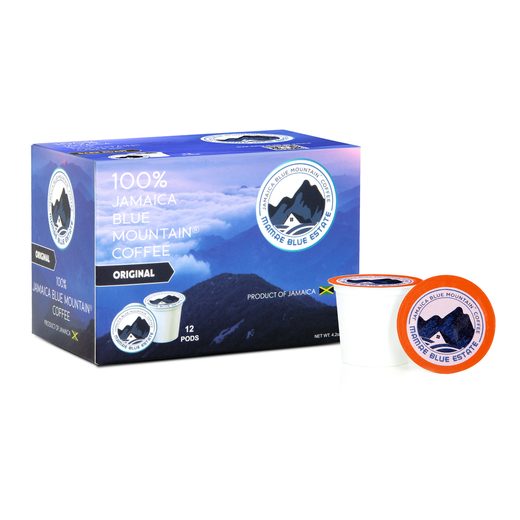
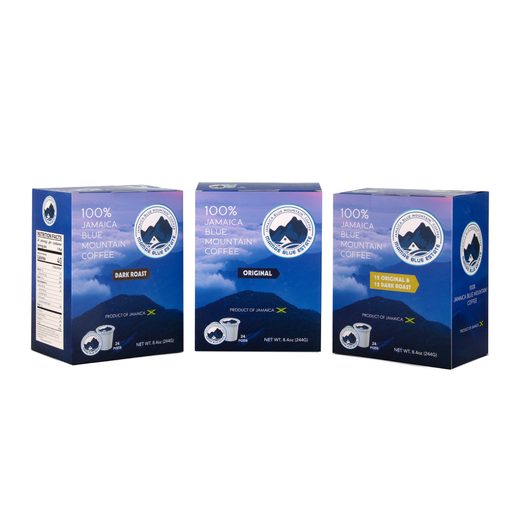
Kenyan and Jamaica Blue Mountain (JBM) coffee represent close to opposite ends of the acidity spectrum. Kenyan coffee, particularly AA and AB lots, is prized for sharp, wine-like acidity and pronounced blackcurrant character. JBM, by contrast, is consistently described by growers and importers as mild and balanced, with notably low bitterness and a gentler, smoother cup. The two origins also differ structurally: Kenya sells much of its crop through a competitive weekly auction that rewards cup quality lot by lot, while JBM comes from a single, legally defined growing area with its own trademark-based verification system rather than an open auction. Drinkers who enjoy Kenya's brightness may find JBM's restraint a useful point of comparison, available to try through whole bean options.
How does Kenyan coffee compare with other origins?
Against Ethiopian coffee, grown from thousands of heirloom varieties, Kenya's reliance on a small number of named cultivars like SL28 and SL34 is a clear point of contrast, even though both origins share a reputation for bright acidity. Against Colombian coffee, generally milder and sweeter, Kenyan lots are typically more intense and acid-forward. All three, along with Jamaica Blue Mountain, are arabica coffees, so these differences come from variety, altitude, soil and processing rather than species.
Questions people ask
What does AA mean in Kenyan coffee?
What is the difference between AA and AB Kenyan coffee?
What is SL28 coffee?
What is the Nairobi Coffee Exchange?
Why is Kenyan coffee so acidic?
How does Kenyan coffee compare to Jamaica Blue Mountain?
Sources
- Kenya Grades Explained — Trabocca
- Kenya Coffee Grades: AA, AB & Classification Guide — Crosby Coffee
- Exploring popular Kenyan coffee varieties: SL-28 & SL-34 — Perfect Daily Grind
- Kenyan Coffee Varieties: A Comprehensive Overview — Trabocca
- Auctioning Coffees At Origin: Kenya's Coffee Exchange — Royal Coffee
- Nairobi Coffee Exchange — Wikipedia
- The Ultimate Guide to Kenyan Coffee: Regions, Varieties, Processing & Grading — 1Zpresso
- Understanding the Process: Double Fermentation — Barista Magazine
Taste the benchmark
More in Origins
- Kona Coffee: Hawaii's Famous Coffee, and What 'Kona Blend' MeansKona coffee grows on a tiny Big Island belt and, until a 2024 law tightened the rule, a blend needed only 10% real Kona coffee to use the name.
- Malawi CoffeeMalawi grows a small, smallholder highland coffee crop centered on Mzuzu and the Misuku Hills, overshadowed for a century by tobacco and tea.
- Mexican Coffee: Chiapas, Veracruz, Oaxaca and Café de OllaMexican coffee comes mostly from small indigenous farms in Chiapas, Veracruz, Oaxaca and Puebla, prized for a mild, low-acid, everyday cup.
- Monsooned Malabar CoffeeMonsooned Malabar exposes Indian coffee to monsoon humidity for months, replicating old sailing-ship voyages and producing a low-acid, heavy-bodied cup used in espresso.
- Myanmar CoffeeMyanmar's small arabica coffee industry centers on Shan State and the hill town of Pyin Oo Lwin, and now operates inside a currency-disrupted economy.
- Nepal CoffeeNepal's smallholder, largely organic coffee farms span more than 40 mid-hill districts, producing a few hundred tonnes a year at high altitude.
- Nicaraguan CoffeeNicaragua grows a brighter, citric and floral coffee across Jinotega, Matagalpa and the rising Nueva Segovia region.
- Panamanian Coffee Beyond Geisha: Boquete and VolcánBeyond its famous Geisha, Panama's Boquete and Volcán regions mostly grow Catuaí, Caturra and Mundo Novo on small farms and old estates.