Coffee Roast Levels: Light, Medium and Dark Roast Compared
Roast level changes a coffee more than almost any other step after harvest. This guide explains what light, medium and dark mean, how they change the cup, and what a 2024 study found about caffeine.
Coffee roast levels are the simplest label on a bag and one of the least standardized. "Light", "medium" and "dark" describe how far a roaster took the beans, but there is no legal definition, and one roaster's medium can be another's dark. This guide explains what actually happens at each coffee roast level, how roast changes flavor, acidity and body, what the research says about caffeine, and how to choose a roast for the coffee in front of you, including a mild, high-grown coffee such as Jamaica Blue Mountain.
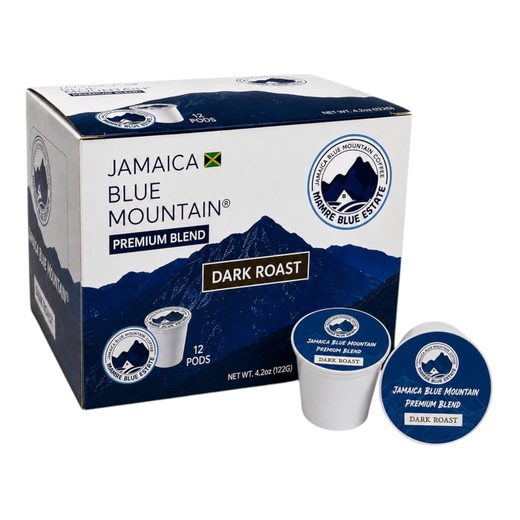
What roasting does to a coffee bean
A green coffee bean is a dense, grassy-smelling seed with roughly the moisture content it left the mill with (see our guide to green coffee beans). Roasting drives off that water and sets off the browning reactions that create coffee's aroma and color. Along the way the bean loses about 15 to 18% of its mass, mostly water, and its volume roughly doubles as vapor builds up inside it, according to the summary in Wikipedia's coffee roasting article.
Two audible events mark the roast. First crack, at a bean temperature of roughly 196 °C (385 °F), is the sound of the bean expanding as steam escapes. Second crack, at roughly 224 °C (435 °F), comes as the bean's cell structure starts to break down. Roasters use these two cracks as landmarks: most light roasts are finished soon after first crack, medium roasts somewhere between the cracks, and dark roasts at or past second crack. The temperatures are approximate and depend on the roaster and where the probe sits.
Roast names and approximate temperatures
Older roast names are still printed on bags. The bean temperatures below are the commonly cited end points listed in Wikipedia's coffee roasting article; treat them as a rough map, not a rule.
| Traditional name | Approx. bean temperature | Usually sold as |
|---|---|---|
| Cinnamon | 196 °C (385 °F) | Very light |
| New England | 205 °C (401 °F) | Light |
| American | 210 °C (410 °F) | Light to medium |
| City | 219 °C (426 °F) | Medium |
| Full City | 225 °C (437 °F) | Medium-dark |
| Vienna | 230 °C (446 °F) | Dark |
| French | 240 °C (464 °F) | Very dark |
| Italian | 245 °C (473 °F) | Very dark |
Professional roasters often measure color instead of relying on names, using an Agtron-type meter on which lower numbers mean darker coffee. For example, the color target for samples in the Specialty Coffee Association's cupping procedure, as summarized by the importer Royal Coffee, is a light-to-medium reading of about 63 on the Agtron Gourmet scale. That is why coffees are judged at a fairly light roast: it shows the bean's own character (see how to cup coffee).
Light roast
Light roasts end near or shortly after first crack. They keep the most of what the bean brought from the farm: origin character, fruit and floral notes, and bright acidity. Wikipedia's summary describes acidity as sharp at the lightest roasts and falling steadily as roasting continues, while body is lighter. Light roasts are popular for washed and natural specialty coffees whose appeal is fruit and clarity (see washed coffee and natural process coffee). The trade-off is that a light roast can taste grassy or sour if it is underdeveloped, and it is less forgiving of a weak green coffee.
Medium roast
Medium roasts finish between first and second crack. Acidity is softer, sweetness and caramel notes are more developed, and body is fuller. For most drinkers this is the balance point, and it is where many mild, high-grown coffees are sold, because the roast adds sweetness without burying the bean's own flavor. If a coffee is prized for smoothness and balance rather than intensity, a medium roast is usually the safest way to taste it.
Dark roast
Dark roasts reach second crack or go beyond it. Roast flavors take over: bittersweet chocolate, smoke, toast, and at the far end a burnt or ashy edge. Wikipedia's summary notes that acidity is diminished by French roast and nearly gone by Italian, and that body peaks around Full City before thinning again at the darkest roasts. Oil often appears on the surface. Dark roasts are traditional for many espresso blends and stand up well to milk, but they make it much harder to tell one origin from another, because more of what you taste comes from the roaster than from the farm.
Does dark roast have more caffeine?
This is the most common roast question, and the honest answer is "not much difference, and it depends how you measure". Caffeine is fairly heat-stable, and Wikipedia's summary says roast level does not change caffeine content significantly. Because dark beans are larger and lighter, a scoop of dark roast holds less coffee by weight than a scoop of light roast, so measuring by volume tends to favor light roasts slightly.
A 2024 study in Scientific Reports by researchers at Berry College and Drexel University tested two Ethiopian coffees at five roast levels, brewed in an AeroPress at a fixed 15:1 ratio. Under identical brewing, the darkest roasts gave lower caffeine concentrations than light and medium roasts, while at the same extraction yield the dark roasts were higher. As reported by Daily Coffee News, caffeine in the cup peaked in medium roasts that had lost about 14 to 16% of their mass. The authors' point is that extraction and brewing matter at least as much as roast level, so the choice of roast is better made on taste.
How to choose a roast level
- Start with the coffee, not the roast. Coffees bought for origin character (a single estate, a rare variety, a fruit-forward natural) are usually best at light to medium roast.
- Think about milk and sugar. If you drink coffee with milk, a medium-dark or dark roast keeps its flavor; black drinkers often notice more in lighter roasts.
- Match the brewer. Pour-over and drip show off light and medium roasts; espresso and moka pots are more forgiving of medium-dark roasts. Our brewing guide has starting recipes.
- Check the roast date. Any roast tastes flat when stale. See how to store coffee beans for how long roasted coffee keeps.
- Taste two roasts side by side. Brew them the same way and compare; it is the quickest way to learn your own preference.
Roast level and Jamaica Blue Mountain
Jamaica Blue Mountain is known for mildness, balance and low bitterness (see what Blue Mountain coffee tastes like). Those qualities are easiest to taste at a light to medium roast; a very dark roast moves the flavor toward the roast itself and makes any coffee taste more alike, which is one reason dark-roasted "Blue Mountain style" products are hard to judge by taste alone (see Blue Mountain style coffee). Roast level also tells you nothing about origin or blend percentage: a bag labeled "Blend" may contain as little as 30% Blue Mountain under Jamaican rules, whatever its roast (see Blue Mountain blend).
Disclosure: this site is published by Mamre Blue Coffee, a Jamaica Blue Mountain estate (see about us), so we rely on official and independent sources for the facts on this page.
Questions people ask
What is the difference between light, medium and dark roast coffee?
Does dark roast coffee have more caffeine than light roast?
Is there an official standard for roast names?
Which roast is best for Jamaica Blue Mountain coffee?
Why do coffee beans get bigger when roasted?
Sources
- Coffee roasting (Wikipedia)
- Lindsey et al., Caffeine content in filter coffee brews as a function of degree of roast and extraction yield (Scientific Reports, 2024)
- Do Light Roasts or Dark Roasts Have More Caffeine? Study: Maybe Medium (Daily Coffee News, Nov 26 2024)
- How to Set Up and Run a Coffee Cupping: A Step-by-Step Guide (Royal Coffee)
- The Jamaica Agricultural Commodities Regulatory Authority Regulations, 2018 (Jamaica Gazette)
Taste the benchmark


More in Coffee knowledge
- Ethiopia's Coffee Trademarks: Harrar, Sidamo and YirgacheffeFrom 2004 Ethiopia registered Harrar, Sidamo and Yirgacheffe as trademarks abroad and licensed them royalty-free, a different route to protecting famous origin names than Jamaica or Colombia took.
- History of Jamaica Blue Mountain Coffee, from 1728 to JACRACoffee reached Jamaica in the 1720s; the Blue Mountain name became a regulated, certified product only in the 20th century, through the 1944 clearing house, the 1950 Coffee Industry Board and, since 2017, JACRA.
- How to Brew Jamaica Blue Mountain Coffee at HomeBrew Blue Mountain like any good washed arabica, but gently: fresh whole beans, about 1 to 2 tablespoons per 6 ounces of water, water just off the boil, and a grind matched to the method so that its mild, low-bitterness character is not over-extracted.
- How to Cup Coffee: A Step-by-Step Guide to Coffee CuppingCupping is how coffee is bought, graded and scored around the world. It looks like a ritual, but it is a simple, repeatable recipe that anyone can follow at home with a scale, a kettle and two spoons.
- How to Spot Fake Jamaica Blue Mountain CoffeeJamaica's regulators have chased counterfeit Blue Mountain coffee for over a decade; buyers can screen out most of it by reading the label carefully and asking where the coffee came from.
- How to Store Coffee Beans So They Stay FreshRoasted coffee does not go off like milk, but it does go stale. Air, moisture, heat and light are the enemies. Here is how to store whole beans and ground coffee, and how long each keeps.
- Hurricane Melissa and Jamaica Blue Mountain CoffeeMelissa hit Jamaica in October 2025 at the start of the coffee harvest. Official reports put early damage to the coffee industry at about 35%, and JACRA has since led a replanting and input programme.
- Italian Coffee CultureItalian coffee culture runs on the standing espresso bar and the stovetop moka pot, backed by more than a century of machine history and widely followed customs.