Jamaica Blue Mountain Blend: What the 30% Rule Means
Jamaica's 2018 regulations let a coffee be called a Jamaica Blue Mountain Blend if Blue Mountain coffee is at least 30% of its weight, up from 20% under the old 1953 rules.
A coffee labeled "Jamaica Blue Mountain Blend" only has to contain 30% Jamaica Blue Mountain coffee by weight. That floor comes from Jamaica's 2018 commodity regulations, and it means the other 70% of a legal blend can be coffee from anywhere.
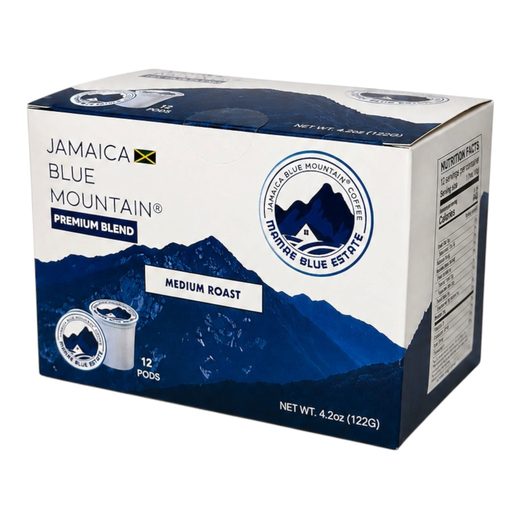
What does the law say about Blue Mountain blends?
The Jamaica Agricultural Commodities Regulatory Authority Regulations, 2018, define "Jamaica Blue Mountain Blend Coffee" as any coffee or coffee product in which Jamaica Blue Mountain coffee accounts for not less than 30% of the weight. They define "Jamaica High Mountain Supreme Blend Coffee" the same way, with at least 30% High Mountain Supreme coffee by weight. Licensed coffee works that make either kind of blend must keep a record of the source of every ingredient (regulation 23).
The regulations do not set a maximum, require a percentage on the label, or say what the rest of the blend must be. A blend can therefore range from 30% Blue Mountain to something just short of 100%, and two products with the same "Blend" wording can be very different coffees.
Has the blend minimum always been 30%?
No. The Coffee Industry Regulations, 1953, as amended through the 1980s and reproduced in the FAO's FAOLEX database, defined a "blue mountain blend" as coffee in which Blue Mountain coffee accounted for not less than 20% of the weight. The 2018 regulations raised that floor to 30%. The older rules also tied the definition of Blue Mountain coffee itself to processing at listed coffee works, a detail covered on our growing area page.
Is there a similar rule for imported coffee roasted in Jamaica?
Yes, and it is easy to confuse with the blend rule. Regulation 19 says roasted coffee made from imported green beans may not be sold in Jamaica or exported unless it is a blend in which coffee grown in Jamaica makes up at least 30% of the weight. That rule concerns Jamaican-grown coffee in general, not Blue Mountain specifically, so a bag "roasted in Jamaica" is not the same as a bag of Blue Mountain coffee.
How does Jamaica's rule compare with Kona's?
| Jamaica Blue Mountain | Hawaii (Kona and other regions) | |
|---|---|---|
| Minimum share for a blend label | 30% by weight (2018 regulations; 20% under the 1953 rules) | 10% historically; rising to 51% under Act 198 of 2024 |
| When the current rule applies | Since 2018 | Enforcement of the 51% rule from July 1, 2027 |
| Percentage on label | Not required by the regulation text | Historically required to disclose the percentage |
Hawaii allowed a "Kona blend" with as little as 10% Kona coffee under rules adopted in 1991 and 1992, according to a 2023 report prepared for the Hawaii Department of Agriculture, and Daily Coffee News reported that a 2024 law raises the minimum to 51% from July 1, 2027. Once that takes effect, Hawaii's floor will be higher on paper than Jamaica's 30%. Our Kona coffee page covers the Hawaiian side in detail.
Why do Blue Mountain blends exist?
Supply is the short answer. Jamaica grows about 0.1% of the world's coffee, according to a 2023 study in the journal Insects, and the Jamaica Observer reported in 2018 that about 70% of premium Blue Mountain exports go to Japan. That leaves a small amount for every other market. Blending stretches it: a roaster can put the Blue Mountain name, legally, on a product that is mostly other coffee, at a lower price than a 100% bag. Regulation also cuts the other way. Because the blend floor is a legal definition, a roaster who uses the Blue Mountain name on a product with less than 30% Blue Mountain coffee, or who drops the word "Blend", is no longer selling a legal blend.
What is in the other 70%?
The regulations do not say. They set a minimum share of Blue Mountain coffee and require licensed coffee works to record the source of each ingredient, but they do not require the remaining coffee to be Jamaican, to be arabica, or to be named on the label. Some producers describe their blending partner coffees; many do not. If the rest of the blend matters to you, ask the seller, and treat silence as an answer. A roaster proud of its blend will usually tell you both the Blue Mountain share and what it is blended with.
How should you read a blend label?
- Look for the word "Blend". If it appears anywhere near "Jamaica Blue Mountain", assume the coffee may be as little as 30% Blue Mountain unless a percentage is printed.
- Look for a stated percentage. Some brands print one; many do not. A stated share above 30% is more informative than adjectives like "premium" or "signature".
- Do not read the large type alone. "Blue Mountain" is often the biggest phrase on a blend bag; the legal qualifier may be smaller.
- Compare against "100%". Only a bag that says 100% Jamaica Blue Mountain is made entirely of coffee from the defined area.
A blend is not a fake. A properly labeled blend made by a licensed producer is a legal product, and some buyers choose one deliberately as a cheaper way to taste the coffee. The problem is the unlabeled or mislabeled kind, covered in how to spot fake Blue Mountain coffee, and the unregulated wording covered in "Blue Mountain style" coffee.
Disclosure: the publisher of this site sells a Premium Blend product. It meets the 30% floor; the exact share above that is not published, which is exactly the kind of gap the regulations leave open. If you want only Blue Mountain coffee, choose a bag marked 100%, such as those in the whole bean range. The full overview is on our Jamaica Blue Mountain coffee page.
Questions people ask
How much Blue Mountain coffee is in a Jamaica Blue Mountain Blend?
Was the blend rule always 30%?
Is a Blue Mountain blend fake?
Is Kona's blend rule stricter than Jamaica's?
Sources
- The Jamaica Agricultural Commodities Regulatory Authority Regulations, 2018 (Jamaica Gazette Supplement, March 2 2018)
- The Coffee Industry Regulations, 1953, as amended (FAOLEX, Food and Agriculture Organization)
- Hawaii Coffee Labeling Report, prepared for HDOA-QAD (GUILD Consulting, Dec 29 2023)
- Hawaii Legislature Approves Landmark Coffee Labeling Bill (Daily Coffee News, May 2 2024)
- Myrie et al., Coffee Berry Borer Activity and Infestation in the High Mountain and Blue Mountain Regions of Jamaica (Insects, 2023)
- Blue Mountain Coffee Day Jan 9 (Jamaica Observer, Dec 31 2018)
Taste the benchmark


More in Coffee knowledge
- Jamaica Blue Mountain Coffee Grades: No. 1, No. 2, No. 3 and PeaberryBlue Mountain export coffee is sorted into size-and-defect classes, from No. 1 down to triage, with peaberry kept separate; a grade describes the beans, not the flavor or the authenticity of the bag.
- Japanese Coffee CultureJapan's coffee culture spans century-old kissaten cafes, vending-machine canned coffee, meticulous pour-over brewing, and a decades-long appetite for Jamaica Blue Mountain.
- The Coffee Belt: Where Coffee GrowsCoffee grows only within a tropical coffee belt, where altitude and climate, more than latitude alone, decide what grows where, and climate change is shifting the map.
- The Coffee Plant: How Coffee GrowsCoffee comes from the flowering shrub Coffea, whose cherries, genuine fruit despite the name bean, take three to seven years to reach a first harvest.
- The World's Most Famous CoffeesA guide to why coffees like Jamaica Blue Mountain, Panama Geisha and Kona became famous, not a ranking of which one is best.
- The World's Top Coffee-Producing CountriesBrazil and Vietnam dominate world coffee production, and USDA's country-by-country bag counts show exactly where the rest of the top ten, and tiny Jamaica, rank.
- What Is Specialty Coffee?Specialty coffee traditionally means 80-plus cupping points, but the SCA's current definition covers flavor, origin, growing practices and processing together.
- Why Japan Buys Most Jamaica Blue Mountain CoffeeSince a first direct shipment in 1953, Japan has become the main buyer of Jamaica Blue Mountain coffee, taking around 70% of exports by recent Jamaican estimates.