Kona Coffee: Hawaii's Famous Coffee, and What 'Kona Blend' Means
Kona coffee grows on a tiny Big Island belt and, until a 2024 law tightened the rule, a blend needed only 10% real Kona coffee to use the name.
Kona coffee is Arabica grown on Hawaii's Big Island, on a narrow strip of volcanic soil on the slopes of Hualalai and Mauna Loa. Just 10% actual Kona coffee has been enough, under a decades-old state rule, to put "Kona" on a blend label — a threshold Hawaii voted to raise to 51% starting in 2027.
Where is the Kona coffee district, and why does elevation matter?
The Kona Coffee Farmers Association describes the growing area as a narrow belt on the leeward (western) slopes of the Hualalai and Mauna Loa volcanoes on Hawaii's Big Island — about 30 miles of coastline and barely a mile wide. Elevation runs roughly 800 to 2,500 feet (about 240 to 760 meters). Afternoon clouds are a defining feature: they roll in on most summer days, bringing rain and shading the trees, and the district gets 40 to 60 inches (about 100 to 150 centimeters) of rain a year on volcanic soil. Most Kona coffee comes from small, often family-run farms — KCFA counts about 700 farms, the great majority under 5 acres, with a 50-acre farm considered exceptionally large.
A 2016 University of Hawaii count, cited in a 2023 Hawaii Department of Agriculture (HDOA) report, put the number at about 880 farms run by 480 farmers, covering roughly 3,800 acres, with two-thirds of farms between 3 and 9 acres. On that base, Kona produces an estimated 2 to 3 million pounds of green coffee a year, selling at $20 to $26 a pound, the same report found.
That's a small operation by the standards of most coffee-growing countries, and it shapes how Kona is farmed and sold. With so little land per grower, most Kona farms hand-pick ripe cherry over several passes through the season rather than strip-picking or machine harvesting, and many sell directly to visitors or through small mills rather than to large exporters. The scale also means Kona can never compete on volume with bigger origins — its case for a premium price rests on the district's distinct growing conditions and on the grading and labeling rules covered below.
What does Hawaii's 10% "Kona blend" rule actually mean?
Under a state rule adopted in 1991 and 1992, a product could be labeled "Kona blend" while containing as little as 10% actual Kona coffee, as long as the label disclosed that percentage, according to the 2023 HDOA report. The rule applied to coffee sold within Hawaii; it did not cover coffee that left the state, which helps explain why blends bearing the Kona name have long circulated on the US mainland under varying disclosure practices.
That changed in 2024. Hawaii's legislature passed HB 2298, signed into law as Act 198 on July 3, 2024, raising the minimum share required to use "Kona," or any other Hawaii regional coffee name, on a blend label to 51%, Daily Coffee News reported. Enforcement begins July 1, 2027, giving the industry a multi-year transition period. The same HDOA-commissioned report measured a 45.59% price premium for coffee labeled "Kona" over otherwise similar unlabeled coffee — a figure that helps explain both why blenders wanted the name and why growers pushed to tighten the rule protecting it.
For a buyer, the practical takeaway is to read past the word "Kona" itself. A bag marked "Kona blend" is legally allowed to contain mostly coffee grown somewhere else; a bag marked "100% Kona" is not a blend at all. Because the 10% rule stayed in effect for decades, plenty of blend product using the name is still on shelves and will remain legal to sell until the 2027 enforcement date, so checking for the words "100%" and a stated origin district remains the most reliable shortcut.
How is Kona coffee graded? Extra Fancy, Fancy, No. 1, Prime, and Peaberry
Hawaii has graded its coffee by rule since 1963, and the current standards are set out in the Hawaii Administrative Rules. The main grades, by defect count and bean size, are:
| Grade | Requirement |
|---|---|
| Extra Fancy | No more than 8 full defects per 300 g; minimum bean size Type I, screen 19 |
| Fancy | No more than 12 full defects per 300 g; minimum bean size Type I, screen 18 |
| No. 1 | No more than 18 full defects per 300 g; minimum bean size Type I, screen 16 |
| Select | Up to 5% defective by weight |
| Prime | Up to 15% defective by weight (a limit raised in July 2020) |
| Peaberry | Graded separately; a single, rounded bean from a cherry that set one seed instead of the usual two |
All grades must also meet a moisture standard of 9% to 12%. Peaberry is not a separate variety — it's an ordinary Kona cherry that happened to develop one round bean rather than two flat-sided ones, and roasters sort it out because its shape roasts differently from standard beans. It's usually sold and priced as its own category, marketed as Kona peaberry. The grading system matters for buyers mainly as a floor, not a flavor guarantee: it screens out small and defective beans, but a bag's grade alone does not describe taste, roast, or freshness, all of which affect the coffee at least as much as the size classification does.
What does Kona coffee taste like?
The 2023 HDOA-commissioned report describes the coffee's typical profile as "mellow and fruity, with low acidity." As with most origin descriptions, that's an industry characterization rather than a fixed standard, and roast level changes the result considerably. Kona coffee has drawn praise from prominent visitors for well over a century; the same HDOA report credits Mark Twain, who toured Hawaii in 1866, among the early admirers of the coffee.
The coffee berry borer: how a tiny beetle changed Kona farming
The coffee berry borer (Hypothenemus hampei), a beetle that burrows into coffee cherries and damages the beans inside, was first found in South Kona in August 2010 and publicly announced by the state on September 10, 2010. It later spread to Oahu in 2014 and Maui in 2016, according to University of Hawaii CTAHR extension publications. Left unmanaged, borer damage of 10% to 15% is detectable in the cup during professional cupping. Growers now manage the pest mainly through orchard sanitation — removing and destroying infested cherries promptly — combined with applications of the naturally occurring fungus Beauveria bassiana. USDA's National Agricultural Statistics Service also pointed to coffee leaf rust, a separate fungal disease, as a factor in Hawaii's 2023 production decline. Between the borer and the rust, Kona growers now spend more on pest management than they did before 2010, and the cost of that management is generally reflected in the price of the finished coffee, alongside the labeling premium described above.
How much Kona coffee is produced, and what does it cost?
Kona-specific output is estimated at 2 to 3 million pounds of green coffee a year, as noted above. For Hawaii as a whole — Kona plus other districts such as Ka'u — USDA NASS reported 19.2 million pounds of coffee cherry worth $48.2 million in the 2023-24 season, down from 24.8 million pounds worth $57.1 million the season before, a decline USDA linked partly to pests and disease. Kona-labeled coffee, thanks to both its reputation and the labeling premium noted above, is priced well above unlabeled Hawaii coffee at the farm gate, and that gap generally carries through to retail shelves. Peaberry lots, sorted separately and sold as a distinct category, typically command a further premium over standard-grade Kona; readers curious how that compares with other premium-priced coffees can see the wider roundup at the world's most expensive coffees.
Kona vs Jamaica Blue Mountain: a fair comparison
Kona and Jamaica Blue Mountain (JBM) are both small-island, high-reputation coffees regulated by name, but their rules differ in an important way. JBM's designation is tied to a legally defined growing area in Jamaica's Blue Mountains, in the parishes of St Andrew, St Thomas, and Portland, at what's commonly described as 3,000 to 5,500 feet of elevation, and Jamaica's regulator, JACRA, requires that any product labeled "Jamaica Blue Mountain Blend" contain at least 30% Blue Mountain coffee. Kona's rule, historically, allowed a much smaller share — 10% — before the 2024 law raised it to 51% for sales after mid-2027. The 2023 HDOA report itself noted that most coffee-producing regions with protected names elsewhere in the world don't allow blends like Hawaii's historical approach at all, and at least one industry stakeholder cited JBM's stricter, anti-blending stance as a model worth following.
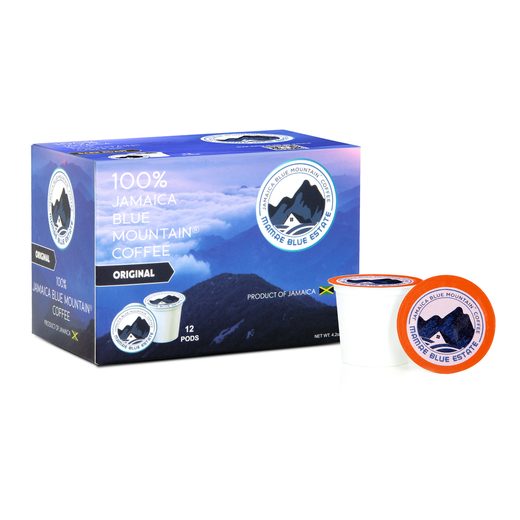
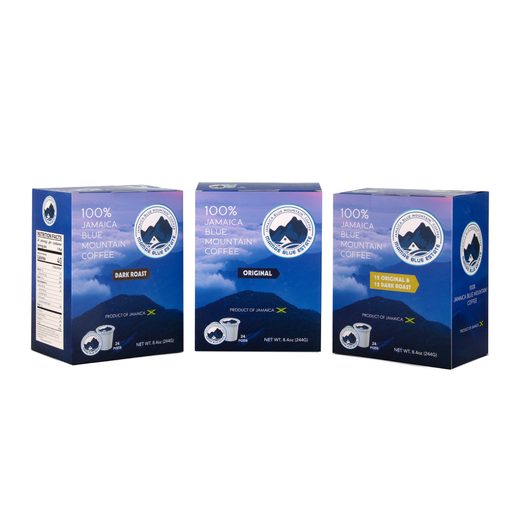
On flavor, both are usually described as mild rather than bold: Kona as mellow and fruity with low acidity, and JBM as mild and balanced with low bitterness. Reliable, apples-to-apples production figures for JBM are harder to pin down than Hawaii's official USDA statistics, so this guide doesn't attempt a volume comparison between the two. What can be said is that both names carry a real price premium, and in both cases reading the label carefully — the blend percentage, the grade, the district — matters more than the name alone. Readers comparing rare origins can also see how Geisha and Yemeni coffee earn their reputations, or browse JBM whole bean and pods directly.
Questions people ask
What is Kona coffee?
What does 'Kona blend' mean on a coffee label?
What is Kona peaberry?
What are the official Kona coffee grades?
What does Kona coffee taste like?
How does Kona coffee compare with Jamaica Blue Mountain coffee?
Sources
- Kona Coffee's Unique Ecological and Agronomical Profile (Kona Coffee Farmers Association)
- Hawaii Coffee Labeling Report, prepared for HDOA-QAD (GUILD Consulting, Dec 29 2023)
- Coffee Berry Borer in Hawaii, FN-61 (University of Hawaii CTAHR, Bittenbender & Nakamoto, June 2021)
- Hawaii Legislature Approves Landmark Coffee Labeling Bill (Daily Coffee News, May 2 2024)
- Hawaii Administrative Rules §4-143-6, Coffee Grading (via Cornell Law School Legal Information Institute)
- Hawaii Coffee: 2023-24 Season Summary (USDA National Agricultural Statistics Service, May 7 2024)
Taste the benchmark
More in Origins
- Malawi CoffeeMalawi grows a small, smallholder highland coffee crop centered on Mzuzu and the Misuku Hills, overshadowed for a century by tobacco and tea.
- Mexican Coffee: Chiapas, Veracruz, Oaxaca and Café de OllaMexican coffee comes mostly from small indigenous farms in Chiapas, Veracruz, Oaxaca and Puebla, prized for a mild, low-acid, everyday cup.
- Monsooned Malabar CoffeeMonsooned Malabar exposes Indian coffee to monsoon humidity for months, replicating old sailing-ship voyages and producing a low-acid, heavy-bodied cup used in espresso.
- Myanmar CoffeeMyanmar's small arabica coffee industry centers on Shan State and the hill town of Pyin Oo Lwin, and now operates inside a currency-disrupted economy.
- Nepal CoffeeNepal's smallholder, largely organic coffee farms span more than 40 mid-hill districts, producing a few hundred tonnes a year at high altitude.
- Nicaraguan CoffeeNicaragua grows a brighter, citric and floral coffee across Jinotega, Matagalpa and the rising Nueva Segovia region.
- Panamanian Coffee Beyond Geisha: Boquete and VolcánBeyond its famous Geisha, Panama's Boquete and Volcán regions mostly grow Catuaí, Caturra and Mundo Novo on small farms and old estates.
- Papua New Guinea CoffeePapua New Guinea grows syrupy, often fruity Arabica across Highlands smallholder gardens and estates, producing an estimated 45,371 tonnes in 2023.