How to Spot Fake Jamaica Blue Mountain Coffee
Jamaica's regulators have chased counterfeit Blue Mountain coffee for over a decade; buyers can screen out most of it by reading the label carefully and asking where the coffee came from.
Fake Jamaica Blue Mountain coffee is common enough that Jamaica's regulators have run repeated enforcement drives against it. The most reliable defenses for a buyer are simple: insist on the words "100% Jamaica Blue Mountain", know what "Blend" and "style" mean, and buy from a seller who can name the Jamaican source.
How big is the counterfeit problem?
Large enough to show up in national export figures. In 2014 the Coffee Industry Board estimated about US$4 million in lost export earnings from counterfeit Blue Mountain coffee over 2013 and 2014, Daily Coffee News reported, and set up a Brand Infringement and Enforcement Task Force that searched for counterfeit coffee online and in stores, bought and tested Blue Mountain-labeled coffee, and gave Jamaica Customs a list of licensed dealers. In 2020 JACRA, the board's successor, announced a further drive with the National Compliance and Regulatory Authority and the Major Organised Crime Authority, saying the sector was losing millions of dollars to coffee misrepresented as Blue Mountain or High Mountain, according to the Jamaica Observer.
Counterfeiting takes several forms: coffee from elsewhere sold under the Blue Mountain name, blends sold as if they were 100%, and wording designed to suggest Blue Mountain without legally claiming it.
Eight checks before you buy
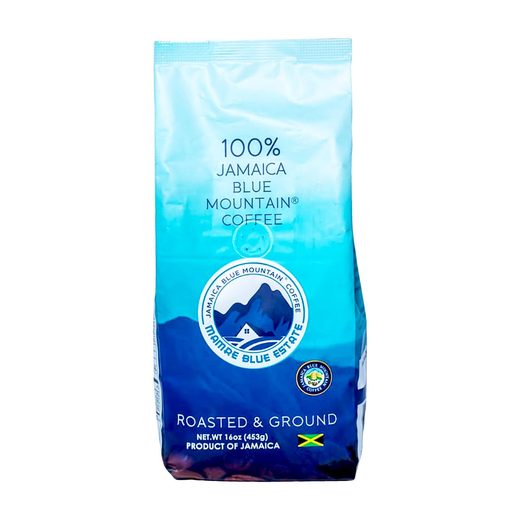
- Look for "100%". Under Jamaica's 2018 regulations, a "Jamaica Blue Mountain Blend" needs only 30% Blue Mountain coffee by weight. If the bag does not say 100%, assume it may be a blend. See the 30% blend rule.
- Read the small print, not the headline. "Blue Mountain" is often the biggest phrase on the bag. Look for "blend", "style", "type", "roast" or "flavored" nearby.
- Check for "Jamaica" and "Product of Jamaica". The protected name is Jamaica Blue Mountain. "Blue Mountain" with no country, or a different country of origin on the back, is a warning sign. See "Blue Mountain style" labels.
- Look for a named source. Genuine coffee comes from registered farms and licensed coffee works, and roasters usually say which estate, works or exporter they buy from. A seller who cannot answer that question is a poor bet.
- Be wary of prices far below the market. Blue Mountain is a small, regulated crop; a 100% bag priced like supermarket coffee should prompt questions. Our price comparison shows typical ranges.
- Do not rely on a barrel, a flag or a mountain picture. Wooden barrels, Jamaican colors and mountain artwork are packaging choices. Anyone can use them.
- Treat "Grade 1" as a description, not a guarantee. A grade describes bean size and defects; it says nothing about origin. See Blue Mountain grades.
- Know where you are buying. Marketplace listings can change sellers behind the same product page. Buying direct from a Jamaican estate or a long-standing roaster that names its source reduces the risk.
Is there an official seal to look for?
The Blue Mountain name is protected as a certification mark in the United States (No. 1,414,598) and the United Kingdom (No. 1222993) and as a trademark in the European Union (No. 002093060), according to WIPO, held through Coffee Marks Limited, which the 2018 licence forms describe as wholly owned by JACRA. WIPO's case study says the Coffee Industry Board issued a certificate of authenticity guaranteeing that coffee met its standards, and that its logo could be used only on coffee that had passed all required quality controls.
In practice, retail packaging varies, and the 2018 regulations do not prescribe a consumer seal in their text. A seal or logo is a useful extra signal, but it can be copied. The label wording, the named source and the seller's willingness to document it are more dependable.
What does the law say about misuse of the name?
Regulation 21 of the 2018 regulations makes it an offence, without JACRA's written authority, to buy, sell or export coffee other than the four protected Jamaican categories under a name containing "Blue Mountain" or "High Mountain", or to carry on any coffee trade activity using those words. The maximum penalty is a fine of two million Jamaican dollars, with up to twelve months' imprisonment in default. These rules bind trade in Jamaica; abroad, protection relies on the registered marks and on local consumer and trademark law.
What about coffee bought in Jamaica?
Buying on the island lowers the risk but does not remove it. Roasted coffee sold in Jamaica can legally be made partly from imported beans, as long as Jamaican-grown coffee makes up at least 30% of its weight (regulation 19), and Jamaican coffee is not always Blue Mountain. The same label rules apply: look for "100% Jamaica Blue Mountain" and a named roaster or works. Travellers can carry up to 5 kilograms in personal baggage without a licence under regulation 5, though their home country's customs and food rules still apply.
What if you think you bought a fake?
Keep the packaging and receipt, ask the seller in writing where the coffee came from, and report the listing to the marketplace. Jamaica's regulator, JACRA, has said that offenders know the trademarks and labelling standards that verify authenticity, which is why naming the source is such a good test. If a listing points to this site, or you think something on our pages is wrong, please contact us.
For the background, read how JACRA certifies Blue Mountain coffee and our overview of Jamaica Blue Mountain coffee. Kona buyers face a similar problem, covered on our Kona coffee page.
Questions people ask
How can I tell if Jamaica Blue Mountain coffee is real?
Is cheap Blue Mountain coffee fake?
Has Jamaica taken action against fake Blue Mountain coffee?
Does a wooden barrel mean the coffee is genuine?
Sources
- Jamaica's Coffee Board Cracking Down on Counterfeit Blue Mountain Sellers (Daily Coffee News, Dec 1 2014)
- JACRA Moves to 'Blunt' Sale of Counterfeit Coffee (Jamaica Observer, Feb 12 2020)
- The Jamaica Agricultural Commodities Regulatory Authority Regulations, 2018 (Jamaica Gazette Supplement, March 2 2018)
- In Search of a Perfect Cup: Jamaica Blue Mountain Coffee (WIPO IP Advantage case study)
Taste the benchmark


More in Coffee knowledge
- Italian Coffee CultureItalian coffee culture runs on the standing espresso bar and the stovetop moka pot, backed by more than a century of machine history and widely followed customs.
- JACRA: How Jamaica Certifies Blue Mountain CoffeeJACRA replaced the Coffee Industry Board in 2017 and now registers growers, licenses dealers and coffee works, certifies quality and holds export coffee in its own custody until it ships.
- Jamaica Blue Mountain Blend: What the 30% Rule MeansJamaica's 2018 regulations let a coffee be called a Jamaica Blue Mountain Blend if Blue Mountain coffee is at least 30% of its weight, up from 20% under the old 1953 rules.
- Jamaica Blue Mountain Coffee Grades: No. 1, No. 2, No. 3 and PeaberryBlue Mountain export coffee is sorted into size-and-defect classes, from No. 1 down to triage, with peaberry kept separate; a grade describes the beans, not the flavor or the authenticity of the bag.
- Japanese Coffee CultureJapan's coffee culture spans century-old kissaten cafes, vending-machine canned coffee, meticulous pour-over brewing, and a decades-long appetite for Jamaica Blue Mountain.
- The Coffee Belt: Where Coffee GrowsCoffee grows only within a tropical coffee belt, where altitude and climate, more than latitude alone, decide what grows where, and climate change is shifting the map.
- The Coffee Plant: How Coffee GrowsCoffee comes from the flowering shrub Coffea, whose cherries, genuine fruit despite the name bean, take three to seven years to reach a first harvest.
- The World's Most Famous CoffeesA guide to why coffees like Jamaica Blue Mountain, Panama Geisha and Kona became famous, not a ranking of which one is best.