"Blue Mountain Style" Coffee: Lookalike Labels Explained
Words like "style", "type" and "roast", and the Blue Mountain name used for coffee grown outside Jamaica, sit outside Jamaica's protected categories; here is how to read them.
"Blue Mountain style" coffee is not Jamaica Blue Mountain. Jamaica's 2018 regulations protect only four coffee names, and "style", "type", "roast" or "flavor" versions of Blue Mountain are not among them, so such a label tells you about the seller's marketing, not about where the coffee grew.
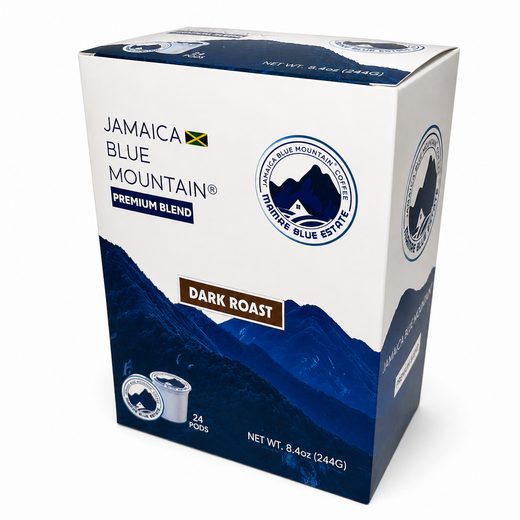
Which Blue Mountain names are actually protected?
The Jamaica Agricultural Commodities Regulatory Authority Regulations, 2018 define Jamaica Blue Mountain Coffee, Jamaica Blue Mountain Blend Coffee (at least 30% Blue Mountain by weight), Jamaica High Mountain Supreme Coffee and Jamaica High Mountain Supreme Blend Coffee (at least 30% High Mountain Supreme). Regulation 21 makes it an offence to trade any other coffee under a name containing "Blue Mountain" or "High Mountain" without JACRA's written authority. Outside Jamaica, the name is protected through certification and trademark registrations in the United States, the European Union and the United Kingdom, according to WIPO.
Everything else is outside those four categories. That does not make every lookalike label illegal everywhere, since that depends on local law, but it does mean none of them is a promise that the coffee came from the Blue Mountain area.
What do the common lookalike labels mean?
| Wording | What it usually means |
|---|---|
| "100% Jamaica Blue Mountain" | The protected name in full; should be coffee entirely from the defined Blue Mountain area |
| "Jamaica Blue Mountain Blend" | A protected blend name; at least 30% Blue Mountain by weight under the 2018 regulations |
| "Blue Mountain style", "type" or "roast" | A seller's description of an intended taste or roast; no legal link to Jamaica |
| "Blue Mountain flavored" | Usually flavoring added to other coffee |
| "Blue Mountain" with another country named | Coffee grown elsewhere, sometimes from plants said to descend from Jamaican stock, or from a local place called Blue Mountain |
| "Jamaican coffee" or "roasted in Jamaica" | Not necessarily Blue Mountain; may be High Mountain or lower-grown Jamaican coffee, or a blend |
Why is there "Blue Mountain" coffee from other countries?
Two reasons. First, the name has travelled with the plants. Papua New Guinea's coffee industry is often traced to Jamaican Blue Mountain seeds planted in the Highlands in the 1920s, a story covered on our Papua New Guinea coffee page, and some growers there and elsewhere still describe their Typica-type trees as "Blue Mountain". That describes a plant lineage, at best; it does not make the coffee Jamaica Blue Mountain, which is defined by where it is grown.
Second, "Blue Mountain" is an ordinary place name in several countries. A coffee named after a local hill or district is not necessarily trying to mislead, but the bag should make the real origin obvious. If the country of origin on the back is not Jamaica, the coffee is not Jamaica Blue Mountain.
Why do "style" blends exist at all?
Because the real thing is scarce and costly. Jamaica produces about 0.1% of the world's coffee, according to a 2023 study in the journal Insects, and most Blue Mountain exports go to Japan. Roasters who want to offer a mild, balanced, low-bitterness cup at a lower price sometimes describe a blend of other coffees as "Blue Mountain style". Taste is subjective and the result may be pleasant, but it is a different product.
What taste are "style" blends imitating?
Jamaica Blue Mountain's reputation is for a mild, balanced cup with little bitterness, a description repeated by Wikipedia and across the trade rather than fixed in any regulation. That is a fairly common profile among washed, high-grown arabicas, which is why it can be approximated. A roaster can blend medium-roasted Central or South American coffees to land somewhere near it, and call the result "Blue Mountain style" without using a single Jamaican bean. Whether the imitation is any good is a matter of taste; what it is not is the protected origin. If a "style" coffee is cheaper and you enjoy it, that is a fair choice, as long as you know what you are buying.
Do other famous origins face the same problem?
Yes, and their rules make a useful comparison. Hawaii allowed "Kona blend" labels with as little as 10% Kona coffee for decades, according to a 2023 report prepared for the Hawaii Department of Agriculture, before a 2024 law raised the minimum to 51% from July 2027, as covered on our Kona coffee page. Colombia's "100% Colombian" wording raises similar questions about what a label does and does not promise; see Colombian coffee. In each case, the protected name is precise and the lookalike wording around it is not.
What about coffee roasted in Jamaica?
Jamaica also controls roasted coffee made from imported beans. Under regulation 19, roasted coffee made from imported green coffee may not be sold in Jamaica or exported unless coffee grown in Jamaica makes up at least 30% of its weight. So a bag roasted in Jamaica can still be mostly imported coffee, and Jamaican-grown coffee can be High Mountain or lower-grown rather than Blue Mountain; see Jamaica High Mountain coffee.
A quick way to decide
- Does the bag say "Jamaica Blue Mountain" in full? If not, it is not the protected product.
- Does it say "100%"? If not, it is at best a blend.
- Is the country of origin Jamaica, and is a Jamaican source named? If not, treat the Blue Mountain wording as description only.
For the full checklist see how to spot fake Blue Mountain coffee; for the legal background, JACRA certification; and for how the variety behind the name spread, Typica. The overview is on our Jamaica Blue Mountain coffee page.
Questions people ask
Is "Blue Mountain style" coffee real Blue Mountain?
Can Blue Mountain coffee be grown outside Jamaica?
Is Jamaican coffee always Blue Mountain?
What is the difference between a Blue Mountain blend and Blue Mountain style?
Sources
- The Jamaica Agricultural Commodities Regulatory Authority Regulations, 2018 (Jamaica Gazette Supplement, March 2 2018)
- In Search of a Perfect Cup: Jamaica Blue Mountain Coffee (WIPO IP Advantage case study)
- Myrie et al., Coffee Berry Borer Activity and Infestation in the High Mountain and Blue Mountain Regions of Jamaica (Insects, 2023)
- Jamaican Blue Mountain Coffee (Wikipedia)
- Hawaii Coffee Labeling Report, prepared for HDOA-QAD (GUILD Consulting, Dec 29 2023)
- Hawaii Legislature Approves Landmark Coffee Labeling Bill (Daily Coffee News, May 2 2024)
Taste the benchmark


More in Coffee knowledge
- A Short History of CoffeeFrom a Yemeni Sufi ritual to Ottoman coffeehouses, European trade and colonial plantations, coffee's documented history is stranger than its most famous legend.
- Coffee Auctions: Cup of Excellence and Best of PanamaCup of Excellence and Best of Panama score coffee through blind juries, then auction the winning lots online, often for record prices.
- History of Jamaica Blue Mountain Coffee, from 1728 to JACRACoffee reached Jamaica in the 1720s; the Blue Mountain name became a regulated, certified product only in the 20th century, through the 1944 clearing house, the 1950 Coffee Industry Board and, since 2017, JACRA.
- How to Spot Fake Jamaica Blue Mountain CoffeeJamaica's regulators have chased counterfeit Blue Mountain coffee for over a decade; buyers can screen out most of it by reading the label carefully and asking where the coffee came from.
- Italian Coffee CultureItalian coffee culture runs on the standing espresso bar and the stovetop moka pot, backed by more than a century of machine history and widely followed customs.
- JACRA: How Jamaica Certifies Blue Mountain CoffeeJACRA replaced the Coffee Industry Board in 2017 and now registers growers, licenses dealers and coffee works, certifies quality and holds export coffee in its own custody until it ships.
- Jamaica Blue Mountain Blend: What the 30% Rule MeansJamaica's 2018 regulations let a coffee be called a Jamaica Blue Mountain Blend if Blue Mountain coffee is at least 30% of its weight, up from 20% under the old 1953 rules.
- Jamaica Blue Mountain Coffee Grades: No. 1, No. 2, No. 3 and PeaberryBlue Mountain export coffee is sorted into size-and-defect classes, from No. 1 down to triage, with peaberry kept separate; a grade describes the beans, not the flavor or the authenticity of the bag.