Indian Coffee: Chikmagalur, Coorg and Araku
India grows both arabica and robusta under shade across Karnataka, Kerala and Tamil Nadu, from Chikmagalur's colonial-era estates to tribal-grown Araku Valley.
India grows both arabica and robusta beneath a canopy of shade trees across three southern states, led by Karnataka's Chikmagalur and Kodagu districts. The Coffee Board of India oversees an industry that traces its start to a 17th-century Sufi saint said to have smuggled seven beans from Yemen.
How much coffee does India produce, and where?
India is the world's ninth-largest coffee producer, with the FAO putting 2023 production at roughly 332,800 tonnes, according to Wikipedia's summary of world coffee production. Karnataka dominates the industry, growing around 71% of the national crop, followed by Kerala at about 21% and Tamil Nadu at roughly 5%, per Wikipedia's summary of Indian coffee production.
Within Karnataka, Kodagu district — also known by its anglicized name, Coorg — is the country's single largest coffee-growing area, contributing about 33% of India's total output on its own, according to Wikipedia's article on the district. Chikkamagaluru (Chikmagalur) district, just north of Kodagu, is smaller but historically the more storied of the two: it's where coffee cultivation in India is traditionally said to have begun.
How did coffee come to India?
The origin story is a good one, even if parts of it rest on local legend more than documented record. Baba Budan, a 17th-century Sufi saint from Karnataka, is said to have smuggled seven raw coffee beans out of the port of Mocha in Yemen in 1670, hidden in his beard, since coffee was normally exported only after roasting to prevent anyone from growing it elsewhere. He planted them on the slopes of what's now called Baba Budangiri, in Chikkamagaluru district, according to Wikipedia's account of his life — a hill range that still bears his name.
Whatever the precise truth of the beard-smuggling detail, Chikkamagaluru is where India's coffee industry traces its roots, and coffee estates remain central to the district's identity and tourism appeal today.
What makes Araku Valley coffee different?
Araku Valley, in Andhra Pradesh's Eastern Ghats, sits outside India's traditional coffee belt but has built a name of its own. The Coffee Board of India began developing plantations there through the Andhra Pradesh Girijan Cooperative Corporation in 1956, aiming to bring a cash crop to the valley's tribal (Adivasi) farming communities, according to Wikipedia's article on the valley; plantations were eventually distributed to families in roughly two-acre plots.
Araku's coffee grows at a lower elevation than most of Karnataka's estates — Wikipedia's article on the valley cites figures of roughly 900 to 1,300 m depending on the specific spot — and it's typically marketed on its cooperative, small-farmer story as much as on cup characteristics.
Shade-grown coffee and the arabica-robusta split
Nearly all of India's coffee is grown under a canopy of shade trees, commonly in two tiers, according to Wikipedia's summary of Indian coffee production. Estates are typically intercropped with spices such as cardamom, black pepper, cinnamon, clove and nutmeg, a practice that both protects the coffee plants and gives growers a second source of income.
Species-wise, the balance has shifted decisively toward robusta in recent decades: it now accounts for more than 60% of national production, with Karnataka alone responsible for about 70% of the country's robusta crop, per the same source. Arabica is generally grown higher, between roughly 1,000 and 1,500 m (3,300–4,900 ft), while robusta is planted lower, from about 500 to 1,000 m (1,600–3,300 ft) — a genuine mix that sets India apart from origins that lean almost entirely on one species.
What varieties does India grow, and how is it processed?
India's commercial coffee relies on a mix of homegrown and imported varieties. On the arabica side, S.795 — a cross of the Kent and S.288 varieties bred in India — is prized for a balanced cup with subtle flavor notes, while Selection 9, a cross of Tafarikela and the rust-resistant Hybrido de Timor, is another locally developed cultivar, according to Wikipedia's summary of Indian coffee production. Robusta growers rely on Indian-selected clones alongside the older Kent variety, first selected in the 1920s.
Both dry (natural) and wet (washed) processing are used, with dry processing described as the traditional method that best preserves fruit character. Arabica cherries take roughly seven months from flowering to ripeness, and robusta around nine, with pickers harvesting by hand once cherries turn a deep red-purple.
What does Indian coffee taste like, and what should buyers look for?
European roasters have long valued Indian coffee for a less acidic, sweeter character than many washed origins, and it's widely used in espresso blends for that reason, according to Wikipedia's summary of Indian coffee production. The country's best-known specialty style is Monsooned Malabar — unwashed beans deliberately exposed to the moist southwest monsoon winds in warehouses near Mangalore from June to September, which swells and yellows the beans and mutes their acidity. More on that process, and the coast it's named for, continues on the Monsooned Malabar coffee page.
How does Indian coffee compare with Jamaica Blue Mountain?
| India | Jamaica Blue Mountain | |
|---|---|---|
| Species grown | Both arabica and robusta, roughly 60%+ robusta nationally | Arabica only (Typica) |
| Typical arabica elevation | Roughly 1,000–1,500 m (3,300–4,900 ft) | Commonly quoted as 3,000–5,500 ft, though not a legal band |
| Growing style | Shade-grown, often intercropped with spices | Single-estate, legally defined growing area |
| Flavor | Widely described as less acidic and sweet; Monsooned Malabar is deliberately low-acid | Widely described as mild and balanced, with low bitterness |
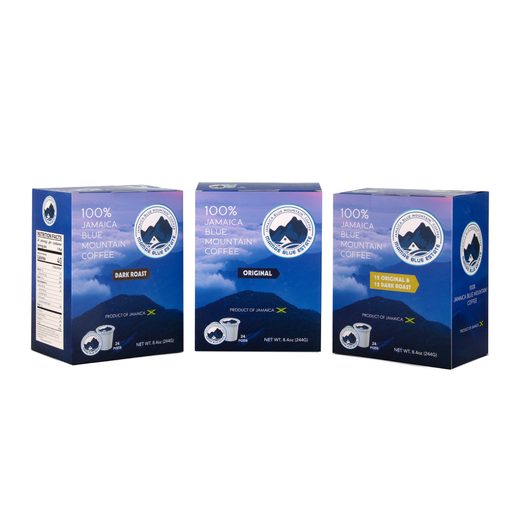
The two origins share more than a first glance suggests: both are associated with a comparatively mild, low-acid style rather than the bright, fruit-forward cups associated with, say, Ethiopian or Kenyan coffee. But the resemblance has different roots. India's mildness comes partly from processing — Monsooned Malabar is deliberately weathered to mute acidity — and partly from a shade-grown, mixed-species growing model spread across a huge coffee belt. Jamaica Blue Mountain's mildness is attributed instead to its single Typica variety and cooler growing temperatures within one legally defined area. Readers who want to compare the two directly can start with Mamre Blue's Jamaica Blue Mountain ground coffee, in the shop.
Questions people ask
Where does Indian coffee grow?
Is Indian coffee arabica or robusta?
Who introduced coffee to India?
What is Monsooned Malabar coffee?
Sources
Taste the benchmark

More in Origins
- Java Coffee: The Island, and Why Coffee Is Called JavaJava is both an Indonesian island and English slang for coffee, a legacy of three centuries as a top coffee source now centered on the Ijen Plateau's washed arabica.
- Kenyan Coffee: AA Grades, SL28 and Bright AcidityA guide to Kenya's grading system, key varieties and regions, with a fair comparison of its bright acidity to Jamaica Blue Mountain.
- Kona Coffee: Hawaii's Famous Coffee, and What 'Kona Blend' MeansKona coffee grows on a tiny Big Island belt and, until a 2024 law tightened the rule, a blend needed only 10% real Kona coffee to use the name.
- Malawi CoffeeMalawi grows a small, smallholder highland coffee crop centered on Mzuzu and the Misuku Hills, overshadowed for a century by tobacco and tea.
- Mexican Coffee: Chiapas, Veracruz, Oaxaca and Café de OllaMexican coffee comes mostly from small indigenous farms in Chiapas, Veracruz, Oaxaca and Puebla, prized for a mild, low-acid, everyday cup.
- Monsooned Malabar CoffeeMonsooned Malabar exposes Indian coffee to monsoon humidity for months, replicating old sailing-ship voyages and producing a low-acid, heavy-bodied cup used in espresso.
- Myanmar CoffeeMyanmar's small arabica coffee industry centers on Shan State and the hill town of Pyin Oo Lwin, and now operates inside a currency-disrupted economy.
- Nepal CoffeeNepal's smallholder, largely organic coffee farms span more than 40 mid-hill districts, producing a few hundred tonnes a year at high altitude.