Brazilian Coffee: How the World's Largest Producer Tastes
Brazil's scale, mechanized farms, and dry processing produce a mild, low-acid, reliably sweet cup unlike small, high-altitude origins.
Brazil grows more coffee than any other country, by a wide margin, and does it at a scale and with methods — mechanized harvesting, dry processing, mostly lower-elevation farms — that have little in common with small, hand-picked, high-altitude origins like Jamaica Blue Mountain. Its cup is famous for being mild, low-acid, and reliably sweet rather than bright or showy.
How much of the world's coffee does Brazil produce?
Brazil has been the world's largest coffee producer for roughly a century and a half, and it currently grows on the order of a third of the world's entire coffee supply — a dominance so pronounced that in the 1920s the country supplied close to 80% of global output, before competition from other producers pulled that share down over the following decades. Recent USDA estimates put Brazil's 2024/25 harvest at roughly 66 million 60-kilogram bags, with a broadly similar crop forecast for 2025/26 — figures that still dwarf any other producing country.
What's the difference between arabica and conilon coffee?
Brazil grows two species at meaningful scale. Arabica, the higher-quality species that dominates specialty coffee worldwide, accounts for roughly 70% of Brazilian production and is grown almost exclusively in Minas Gerais and neighboring states. Conilon — Brazil's name for robusta — makes up the remaining share and is concentrated in Espírito Santo, the country's single largest robusta producer, with additional volume from Rondônia.
Conilon plants tolerate heat, drought, and lower elevations better than arabica, and generally cost less to grow, which is why Brazil leans on it heavily for instant coffee, mass-market blends, and export volume even as arabica remains the backbone of its specialty reputation.
What are Brazil's main coffee regions?
More than 90% of Brazil's coffee comes from four southeastern states — Minas Gerais, São Paulo, Espírito Santo, and Bahia — but a handful of named regions do most of the work in the specialty market:
- Sul de Minas, in southern Minas Gerais, is Brazil's single biggest arabica region, producing roughly 30% of the country's coffee from mostly small farms at an average elevation near 950 m (about 3,100 ft). Its coffees tend to be full-bodied, with mild citrus notes and fruity aromas rather than heavy earthiness.
- Cerrado Mineiro, spanning some 55 municipalities across the Alto Paranaíba, Triângulo Mineiro, and Northwest Minas areas at roughly 800–1,300 m (2,600–4,300 ft), became Brazil's first coffee region to earn Denomination of Origin status, a legal protection modeled on European wine appellations. Its flatter terrain suits mechanized farming, and its coffees are generally described as sweet with medium body and higher acidity than the Brazilian average.
- Mogiana, in the hills of northern São Paulo state, grows coffee at roughly 900–1,100 m (2,950–3,600 ft); its cup is known for sweetness and balance.
- Espírito Santo, Brazil's second-largest coffee-producing state and its largest robusta (conilon) producer, grows mostly conilon at lower elevations, though pockets of higher, cooler ground also produce limited specialty-grade arabica.
How is Brazilian coffee processed?
Virtually all Brazilian coffee is either natural (dry) or pulped-natural processed rather than fully washed, which is unusual for a country that also leads the world in production. In the natural method, whole ripe cherries are spread in thin layers on patios or raised beds and turned frequently while they dry in the sun, typically over one to two weeks, with the fruit's sugars fermenting into the bean and building extra sweetness and body. Pulped-natural coffee has its skin removed first but keeps some or all of the sticky mucilage on during drying, landing between fully washed and fully natural in character.
Why is so much Brazilian coffee harvested by machine?
Brazil's coffee farms are large and, in many regions, planted on relatively flat or gently rolling land — a sharp contrast to the steep mountainsides typical of Central American or Caribbean origins. That terrain, combined with labor costs that are high relative to many other producing countries, has pushed most large farms toward mechanical harvesting. Machines called derricadeiras use vibration to knock ripe cherries loose, and newer models are increasingly selective, allowing multiple passes that target only fully ripe fruit rather than stripping branches clean in a single go. Mechanization is a major reason Brazil can harvest such enormous volumes at a relatively low cost per bag.
What does "Santos" mean on a bag of Brazilian coffee?
Santos is the name of Brazil's historic coffee-exporting port and, by extension, a long-used export grade name rather than a specific growing region. Before the 1990s, Brazilian coffee shipped through the port was classified under grades like Santos 1, Santos 2, and Santos 3; the country's formal grading system has since changed, but "Santos" persisted in trade as a style descriptor — typically a sweet, smooth, medium-bodied, mellow cup rather than a marker of a particular farm or terroir.
How have frosts and Brazilian harvests moved world coffee prices?
Because Brazil supplies such a large share of the world's coffee, a bad Brazilian harvest moves global prices more than almost any other single event. The clearest recent example was the July 2021 frost, described at the time as the country's worst in nearly three decades, which drove temperatures in Minas Gerais — source of most of Brazil's arabica — down to about -1.2°C (29.8°F) and damaged trees just as roughly 70% of that season's crop had already been picked. Estimates of the resulting production loss for the following season ranged from about 2.5 million to 5.5 million bags, and in the following weeks arabica futures jumped roughly 30%, touching seven-year highs above $2.20 per pound on the ICE exchange in New York.
That kind of price swing illustrates how concentrated the world's coffee supply is: a single frost across a handful of Brazilian states can ripple through prices paid for coffees from origins as different as Sumatra and Jamaica, even though none of those coffees come anywhere near the affected farms.
What does Brazilian coffee taste like?
Brazilian coffee is widely described as mild, low in acidity, and well-rounded, with a base of nutty, chocolate, and caramel flavors rather than the bright fruit notes associated with washed coffees from origins such as Kenya or Guatemala — a character shaped as much by natural processing as by variety. There is regional variation: Sul de Minas lots can show mild citrus and fruit tones, Cerrado Mineiro tends toward brighter acidity and sweetness, and Mogiana toward balance. That overall mildness is a big part of why Brazilian coffee is a workhorse in espresso blends, where its low acidity and body provide a smooth base for other origins to build on.
How does Brazilian coffee compare with Jamaica Blue Mountain?
Brazil and Jamaica sit close to opposite ends of coffee production. Brazil grows on the order of a third of the world's coffee on large, often mechanized, mostly lower-elevation farms; Jamaica Blue Mountain comes from a single legally defined growing area within the parishes of St Andrew, St Thomas, and Portland, commonly cited at elevations of 3,000–5,500 ft, hand-picked on a comparatively tiny scale. Both are widely described as mild and low in bitterness, but for different reasons — Brazil's natural, dry processing on one hand, and Jamaica Blue Mountain's washed processing and cooler, high-altitude growing conditions on the other.
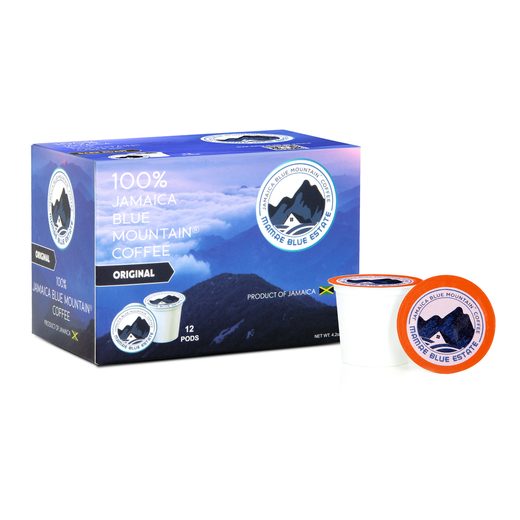
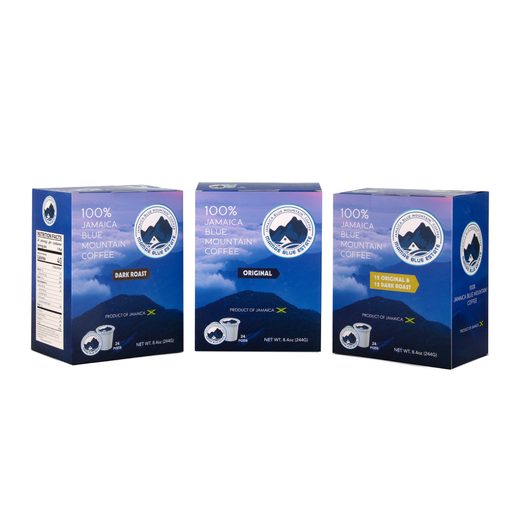
Scale is the real dividing line. A single bad harvest season in Brazil can move world coffee prices; the entire Blue Mountain growing region produces a small fraction of what one mid-sized Brazilian farm might harvest in a year. Jamaica's regulator also enforces a rule that any coffee labeled "Jamaica Blue Mountain Blend" must contain at least 30% actual Blue Mountain coffee — a legal protection that Brazil's regional names generally lack, Cerrado Mineiro's Denomination of Origin being the notable exception. Readers who want to taste that small-scale benchmark directly can find Jamaica Blue Mountain whole bean alongside ground and pod options in the shop.
Questions people ask
What percentage of world coffee comes from Brazil?
Is Brazilian coffee arabica or robusta?
What is Cerrado Mineiro known for?
Why is most Brazilian coffee naturally processed instead of washed?
How did the 2021 frost affect coffee prices worldwide?
How does Brazilian coffee compare with Jamaica Blue Mountain?
Sources
- Coffee production in Brazil — Wikipedia
- Why is frost in Brazil causing global coffee prices to increase? — Perfect Daily Grind
- A Concise Guide to Brazil's Major Coffee-Producing Regions — Perfect Daily Grind
- Sucafina: Santos Natural
- Usda biannual report lowers its estimate of world production for 2024/25 to 174.4 million — Comunicaffe
Taste the benchmark
More in Origins
- Burundi CoffeeBurundi grows old-growth Bourbon coffee through a dense grid of smallholder washing stations centered on Kayanza and Ngozi provinces.
- Cameroon CoffeeCameroon grows a small western-highland arabica crop alongside a much larger robusta crop, both well below the country's 1990 production peak.
- Coffee in Vietnam: The Robusta GiantVietnam is the world's second-largest coffee producer, growing almost entirely robusta in the Central Highlands around Đắk Lắk province.
- Colombian Coffee: Regions, Grades and What "100% Colombian" MeansColombian coffee's regions, grades and FNC labeling explained, with a fair comparison to Jamaica Blue Mountain.
- Congo (DRC) Kivu CoffeeDR Congo's Lake Kivu region grows washed, volcanic-soil arabica that is slowly recovering from decades of conflict and policy-driven decline.
- Costa Rican CoffeeCosta Rica grades its all-arabica crop by altitude across eight regions and is a reference point for honey-processed coffee.
- Dominican Republic CoffeeDominican coffee comes mainly from four mountain regions, including Barahona and Cibao, and is consumed at home largely through brands like Café Santo Domingo.
- Ecuadorian and Galápagos CoffeeEcuador pairs small-lot highland arabica from Loja and Galápagos's San Cristóbal island with one of South America's largest robusta and soluble-coffee industries.