Typica: The Original Arabica Variety
Typica is the oldest cultivated arabica variety, the tall, low-yielding plant that carried coffee from Yemen to the Americas and remains Jamaica Blue Mountain's traditional variety.
Typica is the oldest cultivated variety of arabica coffee, a tall, slow-growing plant first carried out of Ethiopia and Yemen centuries ago. It produces relatively little fruit and resists almost no major coffee disease, yet its clean, well-balanced cup has kept it in cultivation from Latin America to the Caribbean for nearly 300 years.
Where did the Typica coffee variety come from?
World Coffee Research classifies Typica within the Bourbon-Typica genetic group and traces its roots to wild arabica populations in southwestern Ethiopia. Traders carried it to Yemen by the 15th or 16th century, where it became the coffee grown around Mocha for generations before any of it left Arab hands.
By 1700, seed had reportedly reached the Malabar coast of India, and Dutch traders moved plants from Malabar to Batavia, on Java, between 1696 and 1699 — the first step in coffee's spread through European colonial networks, according to World Coffee Research's variety catalog.
How did Typica spread through Java, the Dutch and the French?
A single plant from Java reached the Amsterdam botanical garden in 1706, and its descendants supplied nearly all of the Typica that later reached the Americas. The Dutch shared cuttings with France in 1714, and from there the variety moved quickly through French, Dutch and Spanish colonial networks.
French stock reached Martinique by 1723 and Cayenne, in French Guiana, by 1722; Dutch plants reached Suriname in 1719. From these Caribbean and South American footholds, Typica reached northern Brazil by 1727 and southern Brazil by the 1760s, Jamaica by 1730, Santo Domingo by 1735, Cuba by 1748, Costa Rica by 1779 and El Salvador by 1840, according to World Coffee Research's timeline.
Typica is still grown today in Peru, the Dominican Republic and Jamaica, and several regional coffees that trace back to it carry their own local names, including Criollo in parts of Central America and Kona in Hawaii.
What are Typica's plant traits, yield and disease resistance?
| Trait | Rating |
|---|---|
| Stature | Tall |
| Bean size | Large |
| Yield potential | Low |
| Coffee leaf rust resistance | Low resistance / susceptible |
| Coffee berry disease resistance | Susceptible |
| Best altitude | Above 1,600 m (5,250 ft) near the equator; above 1,000 m (3,280 ft) at higher latitudes |
| Quality potential at high altitude | Very Good |
World Coffee Research describes Typica as "a tall variety characterized by very low production, susceptibility to the major diseases, and good cup quality" — a combination that explains both its decline on commercial plantations and its persistence in specialty coffee. Trees take about four years to reach first production, longer than many modern hybrids.
What does Typica coffee taste like?
Because Typica underlies so many regional coffees, no single flavor defines it; cup character depends heavily on where and how it is grown. World Coffee Research rates its quality potential at high altitude as "Very Good," and roasters and importers commonly describe well-grown Typica as clean and sweet with gentle acidity, without the pronounced fruit or floral notes associated with some newer varieties.
How do growers and buyers use Typica today?
Typica's low yield and vulnerability to leaf rust pushed most large producers toward higher-yielding varieties during the 20th century, and by the 1940s it had lost its dominance across much of Latin America. Farmers who keep it today are usually trading yield for reputation: Typica's name on a bag signals an heirloom variety with a long track record in the cup, which specialty buyers are often willing to pay for. Bourbon, a related but separately introduced Yemeni-Ethiopian variety, became the more commercially favored alternative in many countries because of its higher yield.
How does Typica compare with Jamaica Blue Mountain?
Typica is, according to Mamre Blue, the arabica variety traditionally grown as Jamaica Blue Mountain coffee — one of the clearest living links between the original Ethiopian-Yemeni coffee stock and a modern specialty-market name. Where most of the world moved on to higher-yielding varieties, the legally defined Blue Mountain growing area has kept Typica in the ground for centuries, in part because its buyers have historically paid enough to offset the lower yield.
Typica's general reputation for a clean, balanced cup lines up with how Jamaica Blue Mountain is usually described — mild, balanced and low in bitterness — though that overlap is partly circular, since Blue Mountain's flavor has helped define what people expect from well-grown Typica in the first place. Readers curious about that connection can explore Jamaica Blue Mountain coffee for themselves, alongside other varieties on the varieties hub or the closely related arabica species overview.
Questions people ask
What is Typica coffee?
Is Typica the same as Jamaica Blue Mountain coffee?
Why isn't Typica grown as widely as it used to be?
What does Typica coffee taste like?
Sources
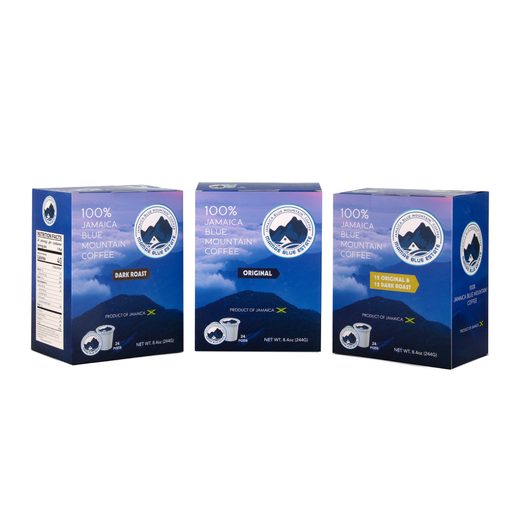
Taste the benchmark

More in Varieties
- Wush Wush CoffeeWush Wush is an Ethiopian landrace coffee now grown as a specialty variety in Colombia, prized for an unusually wide, fruit-driven flavor range.
- Arabica Coffee vs Robusta, Liberica and ExcelsaA clear comparison of arabica, robusta, liberica and excelsa coffee, plus what "100% arabica" actually promises on a label.
- Bourbon: The Coffee VarietyBourbon is the arabica variety isolated on the Indian Ocean island of Réunion for over a century, later spreading through Latin America and producing Caturra and Catuaí.
- Castillo CoffeeCastillo is a coffee-leaf-rust-resistant arabica variety bred by Colombia's Cenicafé and released in 2005, and its cup quality has been debated ever since.
- Catimor and Sarchimor CoffeeCatimor and Sarchimor are rust-resistant coffee hybrids bred by crossing the Timor Hybrid with Caturra and Villa Sarchi, now grown from Latin America to Yunnan.
- Catuaí CoffeeCatuaí is a compact hybrid of Mundo Novo and Caturra bred in Brazil in 1949, grown today in yellow and red forms across Brazil and Central America.
- Caturra CoffeeCaturra is a naturally dwarf Bourbon mutation discovered in Brazil in the early 1900s that became one of Latin America's most widely planted coffee varieties.
- Ethiopian Heirloom (Landrace) Coffee"Heirloom" is the catch-all term for Ethiopia's thousands of native coffee varieties, most still without formal genetic identification.