Wush Wush Coffee
Wush Wush is an Ethiopian landrace coffee now grown as a specialty variety in Colombia, prized for an unusually wide, fruit-driven flavor range.
Wush Wush is an Ethiopian landrace coffee named for the small Wushwush district in the country's southwest, now grown as a specialty variety in Colombia after producers adapted seed there roughly three decades ago. It's prized for an unusually wide, fruit-driven flavor range and for high genetic diversity within the plant itself.
Where does Wush Wush coffee come from?
Wush Wush takes its name from Wushwush, a small district in southwestern Ethiopia near the well-known growing areas of Jimma and Sidamo, according to Perfect Daily Grind. The same fertile highlands are also known for tea production, and Perfect Daily Grind notes the region's tea shares some of the same sensory character found in Wush Wush coffee, a hint at the area's unusual growing conditions.
How did Wush Wush reach Colombia?
Wush Wush followed a path already cleared by Geisha, another Ethiopian variety that became a global specialty-coffee phenomenon after leaving Africa, reaching South America roughly three decades ago, according to Perfect Daily Grind. Elena Lokteva, a green coffee buyer at Ally Coffee, told Perfect Daily Grind that Colombian producers reached it by more than one route: some adapted seed from Cenicafé's nurseries, some brought Wush Wush directly from Ethiopia for research purposes, and others simply replanted from the farms that pioneered it locally. Today it is grown as a specialty variety in Colombia, where altitude and fertile soils support the delicate, floral character buyers look for.
What are Wush Wush's plant traits, yield and disease resistance?
Reports on Wush Wush's agronomics vary depending on who is describing it. Perfect Daily Grind characterizes the variety as low-yielding and genetically diverse, noting that Wush Wush contains more than 20 distinct genotypes and that individual trees vary enough in structure that growers need to select mature, proven trees before replanting. Lokteva, by contrast, described it to Perfect Daily Grind as having "excellent production potential and sufficient tolerance to drought, flood, hot weather and chilly temperatures at higher altitudes," a more optimistic read that may reflect how differently individual Wush Wush genotypes can perform. The beans themselves are notably small and inconsistent in size, according to New Order Coffee director Patrick Seeney, who told Perfect Daily Grind the size variation caused processing problems on his own farm visit.
What does Wush Wush coffee taste like?
Tasters consistently describe Wush Wush as unusually fruit-forward and floral, though specific notes vary widely by lot and process. Lokteva described tasting blueberry, vanilla, maple and lavender in some samples, and spicy, botanical and unripe-strawberry notes in others. New Order's Seeney, cupping a naturally processed lot fermented for 120 hours on raised beds, compared it to "a watermelon Jolly Rancher" with strawberry and floral character, while Jon Allen of Onyx Coffee Lab described his roasted Wush Wush as tropical and very sweet, with notes of date, banana and overripe fruit, all according to Perfect Daily Grind's reporting.
How do growers and buyers use Wush Wush?
For Colombian growers, Wush Wush is a specialty rather than a commodity crop: its low, inconsistent yield and tree-to-tree variation make it a harder plant to farm at scale than mainstream Colombian varieties, so it tends to appear in small, carefully tended lots rather than large plantings. Proud Mary Coffee has bought Wush Wush from Colombia's Finca El Zafiro since 2016, according to Perfect Daily Grind, offering it periodically as part of a "deluxe" specialty range, a pattern typical of how roasters treat the variety: as an occasional rare offering rather than an everyday menu staple.
How does Wush Wush compare with Jamaica Blue Mountain?
Jamaica Blue Mountain and Wush Wush share an origin story more than a flavor profile: both trace back to old-world coffee stock — Blue Mountain to Typica's Ethiopian-Yemeni roots, Wush Wush directly to an Ethiopian landrace — but they have taken very different paths since. Blue Mountain has stayed in one legally defined Jamaican growing area for centuries; Wush Wush left Ethiopia only recently and is still finding its footing in Colombia. In the cup, the contrast is sharper still: Blue Mountain is prized for being mild and balanced with low bitterness, while Wush Wush is sought out for exactly the opposite — bold, varied fruit and floral notes that push toward the intense end of specialty coffee's flavor range. Readers can explore that milder, longer-settled alternative via Jamaica Blue Mountain coffee, read more about Wush Wush's Ethiopian relatives on the Ethiopian heirloom page, or browse the Ethiopian coffee hub for more on the country's coffee.
Questions people ask
What is Wush Wush coffee?
Where is Wush Wush coffee grown?
What does Wush Wush coffee taste like?
Is Wush Wush coffee easy to grow?
Sources
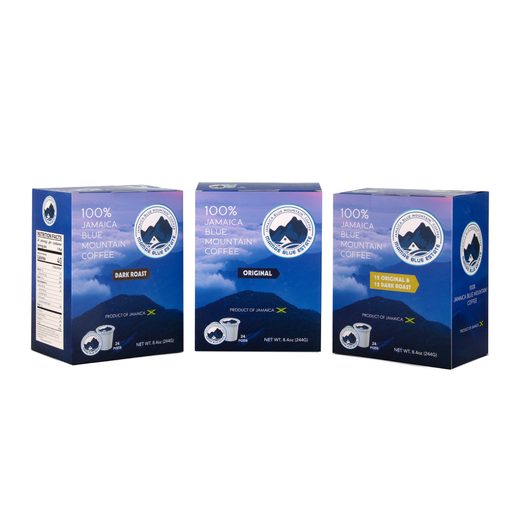
Taste the benchmark

More in Varieties
- Arabica Coffee vs Robusta, Liberica and ExcelsaA clear comparison of arabica, robusta, liberica and excelsa coffee, plus what "100% arabica" actually promises on a label.
- Bourbon: The Coffee VarietyBourbon is the arabica variety isolated on the Indian Ocean island of Réunion for over a century, later spreading through Latin America and producing Caturra and Catuaí.
- Castillo CoffeeCastillo is a coffee-leaf-rust-resistant arabica variety bred by Colombia's Cenicafé and released in 2005, and its cup quality has been debated ever since.
- Catimor and Sarchimor CoffeeCatimor and Sarchimor are rust-resistant coffee hybrids bred by crossing the Timor Hybrid with Caturra and Villa Sarchi, now grown from Latin America to Yunnan.
- Catuaí CoffeeCatuaí is a compact hybrid of Mundo Novo and Caturra bred in Brazil in 1949, grown today in yellow and red forms across Brazil and Central America.
- Caturra CoffeeCaturra is a naturally dwarf Bourbon mutation discovered in Brazil in the early 1900s that became one of Latin America's most widely planted coffee varieties.
- Ethiopian Heirloom (Landrace) Coffee"Heirloom" is the catch-all term for Ethiopia's thousands of native coffee varieties, most still without formal genetic identification.
- Eugenioides CoffeeCoffea eugenioides is one of arabica's two wild parent species, naturally very low in caffeine and essentially absent from commercial coffee production.