Bourbon: The Coffee Variety
Bourbon is the arabica variety isolated on the Indian Ocean island of Réunion for over a century, later spreading through Latin America and producing Caturra and Catuaí.
Bourbon is one of arabica coffee's two founding cultivated lineages, alongside Typica, isolated for more than a century on the Indian Ocean island once called Île Bourbon. It yields more fruit than Typica and is widely praised for excellent cup quality, and its many natural mutations and crosses now dominate coffee farms across Latin America.
Where did the Bourbon coffee variety come from?
French colonists planted Yemeni arabica seed on Île Bourbon — now Réunion, off the coast of Madagascar — in the early 1700s, with World Coffee Research dating the planting to around 1708. Isolated on the island for well over a hundred years, the population developed its own genetic identity, distinct enough from Typica that coffee scientists now treat Bourbon and Typica as the two main branches of the same "Bourbon-Typica" genetic group.
What are the red and yellow Bourbon types?
Bourbon trees naturally produce cherries in more than one color. Red Bourbon, which ripens deep red, is the classic form and the ancestor of most Bourbon-descended varieties. Yellow Bourbon, a naturally occurring mutation that ripens yellow instead, is prized by some growers and cuppers for a slightly different, often sweeter cup, though the difference owes as much to farm-level selection and processing as to the color mutation itself.
How did Bourbon spread, and what descendants did it produce?
Bourbon left Réunion for Brazil around 1860, according to World Coffee Research, and spread rapidly north through Latin America over the following decades. It remains grown today in El Salvador, Guatemala, Honduras and Peru, though descendant varieties have replaced much of the original Bourbon-only crop.
Those descendants are now more widely planted than Bourbon itself. A natural mutation found in Brazil's Minas Gerais state between 1915 and 1918 produced the dwarf variety Caturra; a 1949 cross of Bourbon-descended Mundo Novo with Caturra, bred at Brazil's Instituto Agronômico, produced Catuaí; and a separate natural Bourbon-Typica cross discovered in Brazil produced the highly productive Mundo Novo.
What are Bourbon's plant traits, yield and disease resistance?
| Trait | Rating |
|---|---|
| Stature | Tall |
| Bean size | Average |
| Yield potential | Medium |
| Coffee leaf rust resistance | Low resistance / susceptible |
| Coffee berry disease resistance | Susceptible |
| Best altitude | Above 1,600 m (5,250 ft) near the equator; above 1,000 m (3,280 ft) at higher latitudes |
| Cup quality at high altitude | Very Good |
World Coffee Research notes that Bourbon "produces 20–30% more fruit than Typica strains," according to Wikipedia's summary of the variety, which helps explain why it displaced Typica across so much of Latin America even before its own higher-yielding descendants arrived.
What does Bourbon coffee taste like?
World Coffee Research describes Bourbon as known for "excellent cup quality," particularly from high-altitude farms, and it is commonly cited by roasters as sweeter and more complex than Typica, with good body and balanced acidity. As with most varieties, the exact flavor depends heavily on terroir and processing, but Bourbon's reputation for sweetness is one reason it remains prized even where higher-yielding descendants have taken over most of the acreage.
How do growers and buyers use Bourbon?
For growers, Bourbon is a trade-off: better yield than Typica, but lower yield than Caturra, Catuaí or Mundo Novo, and no meaningful resistance to leaf rust or coffee berry disease. Farmers who keep it in the ground today are often chasing cup quality and a specialty-market premium for heirloom varieties, rather than maximum output per acre. For buyers, a named Bourbon lot — especially Yellow Bourbon from a well-known farm — is generally read as a quality signal, distinct from an unlabeled origin blend; those curious how it stacks up against other named varieties can browse the varieties hub.
How does Bourbon compare with Jamaica Blue Mountain?
Jamaica Blue Mountain is traditionally grown as Typica, not Bourbon, so the two represent different branches of the same Bourbon-Typica genetic group rather than the same plant grown in different places. In the cup, both are generally described as balanced rather than bold: Blue Mountain for its mild, low-bitterness profile, and high-altitude Bourbon for a sweeter, fuller body.
Growers of both varieties trade yield for quality, though Bourbon at least produces meaningfully more fruit than Typica, while Blue Mountain's Typica trees remain among the lowest-yielding arabica in commercial production.
Questions people ask
What is the difference between Bourbon and Typica coffee?
What is Yellow Bourbon?
What coffee varieties descend from Bourbon?
Where is Bourbon coffee grown today?
Sources
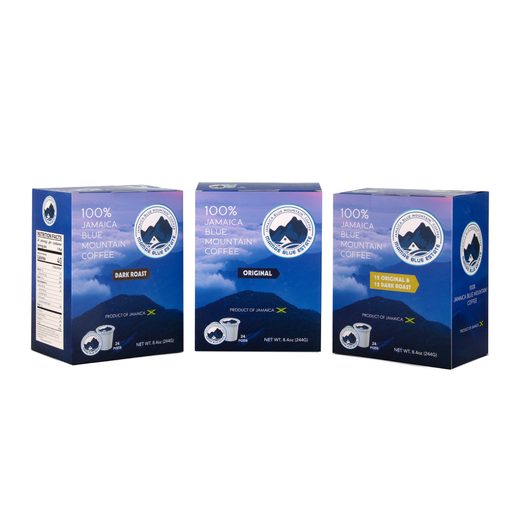
Taste the benchmark

More in Varieties
- Castillo CoffeeCastillo is a coffee-leaf-rust-resistant arabica variety bred by Colombia's Cenicafé and released in 2005, and its cup quality has been debated ever since.
- Catimor and Sarchimor CoffeeCatimor and Sarchimor are rust-resistant coffee hybrids bred by crossing the Timor Hybrid with Caturra and Villa Sarchi, now grown from Latin America to Yunnan.
- Catuaí CoffeeCatuaí is a compact hybrid of Mundo Novo and Caturra bred in Brazil in 1949, grown today in yellow and red forms across Brazil and Central America.
- Caturra CoffeeCaturra is a naturally dwarf Bourbon mutation discovered in Brazil in the early 1900s that became one of Latin America's most widely planted coffee varieties.
- Ethiopian Heirloom (Landrace) Coffee"Heirloom" is the catch-all term for Ethiopia's thousands of native coffee varieties, most still without formal genetic identification.
- Eugenioides CoffeeCoffea eugenioides is one of arabica's two wild parent species, naturally very low in caffeine and essentially absent from commercial coffee production.
- Excelsa CoffeeExcelsa is a tart, chocolatey coffee reclassified as a liberica variety in 2006 and then split back into its own species by 2025 genomic research.
- Laurina (Bourbon Pointu): The Low-Caffeine ArabicaLaurina, also called Bourbon Pointu, is a naturally low-caffeine mutation of Bourbon coffee grown on Réunion Island since the early 1700s.