Castillo Coffee
Castillo is a coffee-leaf-rust-resistant arabica variety bred by Colombia's Cenicafé and released in 2005, and its cup quality has been debated ever since.
Castillo is a coffee-leaf-rust-resistant arabica variety bred by Colombia's Cenicafé research center and released in 2005 after decades of breeding work. It let Colombian farmers keep Caturra's compact, high-yielding habit while adding disease resistance, though its quality drew skepticism that a major sensory trial later challenged.
What is Castillo coffee, and when was it released?
Castillo is an arabica variety bred by Cenicafé, Colombia's national coffee research center, and released to farmers in 2005 after 23 years of additional breeding on top of earlier work, according to Perfect Daily Grind. It followed an earlier Cenicafé release, called simply "Colombia," which came out in 1982 — one year before coffee leaf rust reached the country and turned rust resistance into an urgent national priority. Wikipedia's entry on coffee rust confirms the disease hit Colombia, alongside Costa Rica, in 1983.
Why did Cenicafé breed Castillo?
Cenicafé's genetic improvement program began in 1968 by crossing Caturra with the Timor Hybrid, a natural arabica-robusta cross valued for its rust resistance. The goal for Castillo was to combine Caturra's compact, densely plantable stature with that resistance while also improving on bean size and productivity; Cenicafé eventually released six regional strains bred for Colombia's different growing zones, according to Perfect Daily Grind.
Where is Castillo coffee grown today?
Castillo was bred specifically for Colombian growing conditions and has been planted widely across the country's coffee zones as farmers renovated aging, rust-vulnerable Caturra and Typica plots. Cenicafé's regional strains mean the variety grown in one department may differ slightly from the one grown in another, but all share the same rust-resistant Timor Hybrid ancestry.
What are Castillo's plant traits, yield and disease resistance?
Castillo keeps Caturra's dwarf, compact growth habit, which lets farmers plant it more densely than tall varieties like Typica, and it was bred to combine that habit with resistance to coffee leaf rust inherited from the Timor Hybrid — the trait that drove its development in the first place. Cenicafé also aimed for larger beans and higher productivity than the varieties it was meant to replace, according to Perfect Daily Grind, making it a variety built around output and resilience as much as cup quality.
Does Castillo coffee taste as good as Caturra?
Castillo's Robusta-hybrid ancestry, through the Timor Hybrid, long fed skepticism among specialty buyers that it couldn't match Caturra or Typica in the cup. A 2014–2015 sensory trial run jointly by CIAT, World Coffee Research and Kansas State University tested that assumption directly, growing Castillo and Caturra on the same farms with identical processing. Perfect Daily Grind reports the two varieties scored similarly, with some Castillo lots cupping above 90 points, and that the researchers concluded variety "may be less important than the environment and farm management" — pointing instead to soil fertility, shade and harvest practices as bigger drivers of quality. Perfect Daily Grind also describes Castillo's cup as capable of smoothness, aroma and citric acidity comparable to Typica, Caturra and Bourbon, though some buyers still favor the older varieties by reputation alone.
How do growers and buyers use Castillo?
For Colombian farmers, Castillo is largely a practical choice: it protects a farm's income against coffee leaf rust outbreaks that can otherwise wipe out a harvest, while still fitting the dense planting styles growers are used to from Caturra. For buyers, Castillo now shows up across the spectrum, from everyday commercial lots to competition-grade microlots — the sensory research suggests that whether a specific bag impresses has more to do with the farm behind it than the variety name on the label.
How does Castillo compare with Jamaica Blue Mountain?
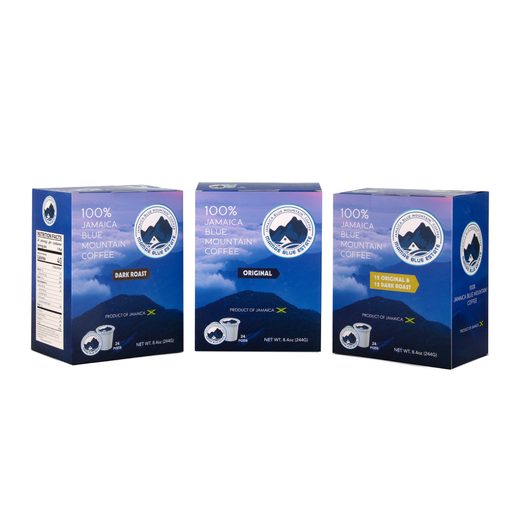
Jamaica Blue Mountain has stayed with Typica for centuries despite its low yield and vulnerability to disease, betting on reputation and buyer loyalty to offset the lower output; Castillo represents the opposite strategy, bred explicitly to trade some of that heritage-variety romance for rust resistance and higher yield. In the cup, Blue Mountain's mild, balanced, low-bitterness profile is a known quantity built on centuries of consistency, while Castillo's quality depends more on the individual farm, closer in that sense to Pink Bourbon and other Colombian specialty names that vary lot to lot. Readers can compare Jamaica Blue Mountain for themselves via Mamre Blue's coffee, or browse more named varieties on the varieties hub.
Questions people ask
What is Castillo coffee?
Why was Castillo coffee developed?
Is Castillo coffee lower quality than Caturra?
Where is Castillo coffee grown?
Sources
Taste the benchmark

More in Varieties
- Catimor and Sarchimor CoffeeCatimor and Sarchimor are rust-resistant coffee hybrids bred by crossing the Timor Hybrid with Caturra and Villa Sarchi, now grown from Latin America to Yunnan.
- Catuaí CoffeeCatuaí is a compact hybrid of Mundo Novo and Caturra bred in Brazil in 1949, grown today in yellow and red forms across Brazil and Central America.
- Caturra CoffeeCaturra is a naturally dwarf Bourbon mutation discovered in Brazil in the early 1900s that became one of Latin America's most widely planted coffee varieties.
- Ethiopian Heirloom (Landrace) Coffee"Heirloom" is the catch-all term for Ethiopia's thousands of native coffee varieties, most still without formal genetic identification.
- Eugenioides CoffeeCoffea eugenioides is one of arabica's two wild parent species, naturally very low in caffeine and essentially absent from commercial coffee production.
- Excelsa CoffeeExcelsa is a tart, chocolatey coffee reclassified as a liberica variety in 2006 and then split back into its own species by 2025 genomic research.
- Laurina (Bourbon Pointu): The Low-Caffeine ArabicaLaurina, also called Bourbon Pointu, is a naturally low-caffeine mutation of Bourbon coffee grown on Réunion Island since the early 1700s.
- Liberica CoffeeLiberica (Coffea liberica) is a rare, giant-beaned coffee species known as kapeng barako in the Philippines, with a fruity, full-bodied cup and under 2% of world output.