Catimor and Sarchimor Coffee
Catimor and Sarchimor are rust-resistant coffee hybrids bred by crossing the Timor Hybrid with Caturra and Villa Sarchi, now grown from Latin America to Yunnan.
Catimor and Sarchimor are two families of rust-resistant coffee hybrids bred by crossing the disease-tolerant Timor Hybrid with high-yielding Caturra and Villa Sarchi, respectively. Developed from the 1950s through the 1970s, they now underpin coffee farming in Central America, Kenya, Vietnam, India and much of China's Yunnan province.
Where do Catimor and Sarchimor come from?
Both Catimor and Sarchimor descend from the same disease-resistant ancestor: the Timor Hybrid, a natural cross between arabica and robusta discovered on the island of Timor and valued for carrying robusta's resistance to coffee leaf rust into an arabica-compatible plant. Catimor was created first, in Portugal in 1959, by crossing the Timor Hybrid with Caturra, according to Wikipedia. Sarchimor followed roughly a decade later, when breeders crossed the Timor Hybrid with Villa Sarchi — a compact Bourbon mutation found in Costa Rica's Alajuela province in the 1950s and 1960s — to create a line known as Hybrid 361 during the 1970s rust crisis.
What is the difference between Catimor and Sarchimor?
The two families share one parent but not the other: Catimor is Timor Hybrid crossed with Caturra, while Sarchimor is Timor Hybrid crossed with Villa Sarchi. Both inherited compact, dwarf growth habits and rust resistance from their Timor ancestry, but breeders in different countries have since developed many named descendants from each cross, including Colombia's Cat129 line from the Catimor side and Marsellesa, released in Nicaragua in 2009, from the Sarchimor side.
What are their plant traits, yield and disease resistance?
Cat129, a Catimor line bred by Cenicafé and later released in Malawi in 2006, is a dwarf, high-yielding plant with large beans that shows intermediate resistance to coffee leaf rust and some resistance to coffee berry disease, according to World Coffee Research's variety catalog. Marsellesa, a Sarchimor descendant, likewise shows intermediate leaf-rust resistance and tolerance to coffee berry disease, with high yield potential and average-sized beans. Both families require denser planting and relatively high nutrition inputs compared with old heirloom varieties, but they reach first production faster and tolerate closer spacing than tall varieties like Typica or Bourbon.
Where are Catimor and Sarchimor grown today?
Wikipedia lists Catimor as grown across Latin America, Indonesia, India — where it is known locally as Cauvery — Vietnam and China's Yunnan province. Yunnan alone accounts for 98% of China's coffee output, and Catimor is described as the region's "varietal of choice" in Wikipedia's entry on coffee production in China. Sarchimor and its descendants are more associated with Costa Rica and India, alongside Central American countries that adopted Sarchimor-line varieties like Marsellesa during rust-resistance replanting drives; Catimor genetics also turn up outside Latin America and Asia, having been bred into Kenya's Ruiru 11 hybrid, created after a 1968 coffee berry disease epidemic there.
What do Catimor and Sarchimor coffees taste like?
Cup quality is the tradeoff most often raised against both families. World Coffee Research rates Cat129's quality potential at high altitude as "Good" rather than exceptional, and Perfect Daily Grind reports that some Kenyan farmers growing the Catimor-descended Ruiru 11 worry its cup falls short of older SL varieties, even as one producer argued "few consumers would be able to taste the difference." Not every descendant fits that pattern, though: World Coffee Research describes Marsellesa's cup as showing "notably high acidity," suggesting quality varies considerably by the specific named descendant, growing altitude and farm management, much as it does with other hybrid families.
How do growers and buyers use Catimor and Sarchimor?
For farmers, Catimor and Sarchimor lines are largely a risk-management choice: rust and other diseases can wipe out a season's income from susceptible varieties, so the resistance bred into these hybrids protects yield even when it doesn't win cupping competitions. Their compact size also allows denser planting than tall heirloom varieties, a practical advantage where land is expensive or limited. For roasters and buyers, coffee from these families most often lands in commercial and mid-tier blends rather than headline microlots, though specific named descendants with strong sensory results, such as Marsellesa, do reach the specialty market.
How do Catimor and Sarchimor compare with Jamaica Blue Mountain?
Jamaica Blue Mountain has kept low-yielding, rust-susceptible Typica in the ground for centuries by relying on buyer loyalty and a legally protected name to offset the cost; Catimor and Sarchimor represent almost the opposite bet, trading some of that heritage cachet for resistance and yield that keep farms solvent through disease outbreaks. In the cup, Blue Mountain's reputation for a mild, balanced, low-bitterness profile reflects generations of selection for flavor alone, while Catimor- and Sarchimor-line coffees are more often bred first for survival and output, with cup quality addressed afterward through specific descendant selection. Readers can compare that heritage approach directly via Jamaica Blue Mountain coffee, see how a related rust-resistant Colombian variety fares on the Castillo page, or browse more named varieties on the varieties hub and the arabica species overview.
Questions people ask
What is the difference between Catimor and Sarchimor coffee?
Where is Catimor coffee grown?
Does Catimor coffee taste worse than other varieties?
Why were Catimor and Sarchimor developed?
Sources
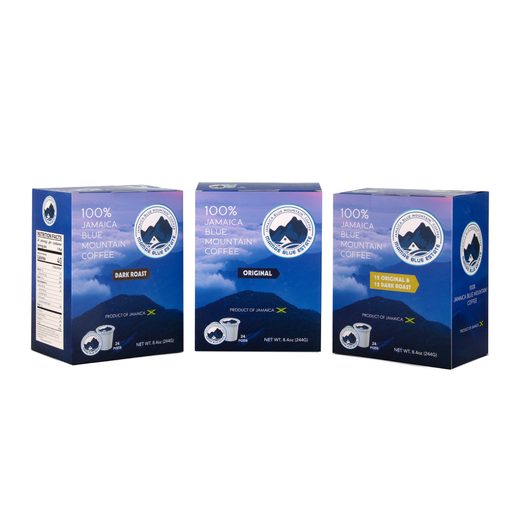
Taste the benchmark

More in Varieties
- Catuaí CoffeeCatuaí is a compact hybrid of Mundo Novo and Caturra bred in Brazil in 1949, grown today in yellow and red forms across Brazil and Central America.
- Caturra CoffeeCaturra is a naturally dwarf Bourbon mutation discovered in Brazil in the early 1900s that became one of Latin America's most widely planted coffee varieties.
- Ethiopian Heirloom (Landrace) Coffee"Heirloom" is the catch-all term for Ethiopia's thousands of native coffee varieties, most still without formal genetic identification.
- Eugenioides CoffeeCoffea eugenioides is one of arabica's two wild parent species, naturally very low in caffeine and essentially absent from commercial coffee production.
- Excelsa CoffeeExcelsa is a tart, chocolatey coffee reclassified as a liberica variety in 2006 and then split back into its own species by 2025 genomic research.
- Laurina (Bourbon Pointu): The Low-Caffeine ArabicaLaurina, also called Bourbon Pointu, is a naturally low-caffeine mutation of Bourbon coffee grown on Réunion Island since the early 1700s.
- Liberica CoffeeLiberica (Coffea liberica) is a rare, giant-beaned coffee species known as kapeng barako in the Philippines, with a fruity, full-bodied cup and under 2% of world output.
- Maragogype: The Elephant BeanMaragogype is a natural Typica mutation discovered in Brazil in 1870, nicknamed the elephant bean for producing some of arabica coffee's largest beans.