Burundi Coffee
Burundi grows old-growth Bourbon coffee through a dense grid of smallholder washing stations centered on Kayanza and Ngozi provinces.
Burundi is one of Africa's smallest coffee producers by volume but one of its most closely watched by specialty buyers, thanks to old Bourbon plantings, a dense network of washing stations, and a hilly, high-altitude landscape well suited to arabica. Coffee is also central to the country's economy, feeding both foreign-exchange earnings and rural household income.
How much coffee does Burundi produce?
Burundi produced roughly 17,000 tonnes of coffee in 2022, according to Wikipedia's summary of the country's economy, a small figure next to East African neighbors like Uganda and Tanzania. Agriculture overall accounts for close to a third of Burundi's GDP, and coffee sits alongside tea, sugar and cotton among the country's leading export crops. Germany is the country's single largest export partner.
Where is Burundi's coffee grown, and at what elevation?
Kayanza and Ngozi, two provinces in Burundi's north-center near the Rwandan border, are the country's best-known specialty regions and have the highest density of washing stations and farmer-training participation, according to the importer Royal Coffee. Gitega, Muramvya, Karuzi, Kirundo and Muyinga are other significant growing areas. Elevation across the coffee belt averages around 1,700 meters (roughly 5,600 ft), Royal Coffee notes, dropping to under 800 meters in the lowlands near Lake Tanganyika, which mostly sit too low for quality arabica.
What coffee varieties does Burundi grow?
As in neighboring Rwanda, old-growth Bourbon dominates Burundian coffee, much of it planted during the colonial period. Royal Coffee identifies two named substrains, Jackson (an early-20th-century Indian selection) and Mbirizi (likely Typica-descended), though most Burundian farmers are unfamiliar with the distinction and simply call their trees "Bourbon."
How is Burundian coffee processed?
About three-quarters of Burundi's coffee is washed, per Royal Coffee. Smallholders pick cherry during the day and deliver it to a washing station that same evening, where it is pulped and left to ferment underwater overnight before drying on raised beds -- a process that can stretch to several weeks during the rainy season. Natural and honey processing exist but remain newer, smaller categories.
Like other coffees from Africa's Great Lakes region, Burundian coffee occasionally shows the "potato taste defect," an off-flavor caused by bacteria entering cherries damaged by the antestia bug. It typically affects only a small share of any given lot, but because it can't be detected until roasting or cupping, it remains one of the trickier quality risks buyers watch for in Burundian coffee.
How is Burundian coffee graded and sold?
Most Burundian coffee moves from smallholder to washing station to exporter, a structure that mirrors Rwanda's more than it does Tanzania's public auction system. Washing stations, whether cooperative- or privately-run, are the key quality checkpoint: the density of stations and the training farmers receive through them is what Royal Coffee singles out as the reason Kayanza and Ngozi stand out from the rest of the country.
When is the harvest, and what does Burundian coffee taste like?
Burundi's main harvest runs from February through June, typically peaking in March and April, according to Royal Coffee. Washed Burundian lots are often described as showing intense citrus flavors, deep blackberry notes and a distinctive tea-like finish, with real complexity and full body -- a cup profile that has made Burundi a favorite among roasters looking for something bolder than a typical East African washed coffee.
How does Burundian coffee compare with Jamaica Blue Mountain?
Burundi and Jamaica both lean on old heirloom varieties grown at real elevation -- Bourbon around 1,700 meters (roughly 5,600 ft) in Burundi's case, against the 3,000-5,500 ft range commonly cited for Blue Mountain -- and both wash-process the bulk of their crop. Burundi's coffee, though, moves through a dense grid of smallholder-fed washing stations rather than Kenya-style auctions or Jamaica's estate-and-factory system.
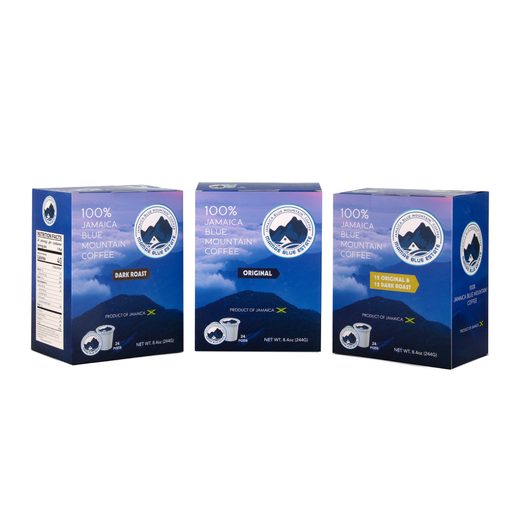
The cup is where the two origins part ways most clearly. Burundi's washed coffee tends toward intense citrus, blackberry and a tannic, tea-like finish, while Jamaica Blue Mountain is widely described as mild, balanced and notably low in bitterness. Buyers curious how that gentler profile sits next to Burundi's bolder cup can start with Jamaica Blue Mountain whole bean in the shop. For more on how origin shapes flavor across the region, see the coffee origins guide.
Questions people ask
How much coffee does Burundi produce?
What are Burundi's main coffee-growing regions?
What does Burundian coffee taste like?
How does Burundian coffee compare with Jamaica Blue Mountain?
Sources
Taste the benchmark

More in Origins
- Cameroon CoffeeCameroon grows a small western-highland arabica crop alongside a much larger robusta crop, both well below the country's 1990 production peak.
- Coffee in Vietnam: The Robusta GiantVietnam is the world's second-largest coffee producer, growing almost entirely robusta in the Central Highlands around Đắk Lắk province.
- Colombian Coffee: Regions, Grades and What "100% Colombian" MeansColombian coffee's regions, grades and FNC labeling explained, with a fair comparison to Jamaica Blue Mountain.
- Congo (DRC) Kivu CoffeeDR Congo's Lake Kivu region grows washed, volcanic-soil arabica that is slowly recovering from decades of conflict and policy-driven decline.
- Costa Rican CoffeeCosta Rica grades its all-arabica crop by altitude across eight regions and is a reference point for honey-processed coffee.
- Dominican Republic CoffeeDominican coffee comes mainly from four mountain regions, including Barahona and Cibao, and is consumed at home largely through brands like Café Santo Domingo.
- Ecuadorian and Galápagos CoffeeEcuador pairs small-lot highland arabica from Loja and Galápagos's San Cristóbal island with one of South America's largest robusta and soluble-coffee industries.
- El Salvador CoffeeEl Salvador is the birthplace of the Pacas and Pacamara varieties and still grows much of its coffee on heritage Bourbon trees.