Antigua Guatemala Coffee
Antigua Guatemala's coffee grows in a volcano-ringed valley on ash-enriched soil, prized for a full, velvety body and chocolate-and-spice flavor.
Antigua Guatemala's coffee is grown in a valley ringed by three volcanoes, on soil enriched by centuries of ash fall. It is one of Anacafé's eight official growing regions and among the best-known Guatemalan coffees internationally, prized for a full, velvety body, chocolate and spice notes, and a clean, moderate acidity.
Where Is Antigua, and How High Is Its Coffee Grown?
Antigua Guatemala is a colonial city in south-central Guatemala, founded in 1543 and serving as the capital of the Captaincy General of Guatemala — then covering most of Central America — for 230 years, until a series of earthquakes forced the capital to move in the 1770s. The city itself sits at about 5,069 ft (1,545 m), and the coffee grown in the surrounding valley climbs a bit higher, generally cited at roughly 4,600–5,600 ft (1,400–1,700 m).
Three volcanoes ring the valley: Agua (12,356 ft / 3,766 m), Fuego (12,346 ft / 3,763 m) and Acatenango (13,045 ft / 3,976 m). Fuego is described as almost constantly active at a low level, and periodic ash fall from it has helped build the valley's volcanic soil over centuries. Coffee has been grown commercially here since at least the mid-1800s, when small plantations took hold in the Antigua and nearby Amatitlán areas as Guatemala began building its coffee export economy.
At 4,600–5,600 ft, Antigua's growing zone is comparatively moderate by Guatemalan standards — well below Huehuetenango, the country's highest and driest region, where coffee climbs to nearly 6,600 ft and frost is enough of a threat that growers credit warm winds off Mexico's Tehuantepec plains with protecting the crop. Antigua's valley floor rarely sees a hard freeze, but growers on the higher flanks of Fuego and Acatenango can still lose young trees on an unusually cold, clear night. For the country's other seven regions and its altitude-based grading system, see our guide to Guatemalan coffee.
What Varieties Grow in Antigua, and How Is the Coffee Processed?
Antigua's coffee is arabica, grown mainly from Bourbon, Caturra and Catuai — three of the best-known arabica cultivars. As in most of Guatemala's specialty regions, Antigua coffee is conventionally washed: ripe cherries are pulped, fermented for roughly a day or two to loosen the mucilage, then rinsed clean and dried, usually on patios or raised beds, before milling and export.
Growers and Anacafé alike credit the valley's volcanic soil and its dependable dry season, from roughly November through April, with letting cherries ripen evenly — a combination that supports the careful, uniform picking behind Antigua's reputation.
What Does Antigua Coffee Taste Like?
Coffee-trade sources commonly describe Antigua coffee as full-bodied and velvety, with a rich, lively aroma and a fine, clean acidity. Roasters often add notes of dark chocolate and warm baking spice, sometimes with a faint hint of smoke — a profile widely attributed to the valley's ash-enriched volcanic soil and its sunny days and cool nights.
That combination of body and restraint is part of why Antigua shows up so often in both single-origin programs, where a lighter roast lets its acidity and spice come through, and in blends, where a medium-to-dark roast Antigua lot adds sweetness and structure without much competing brightness.
How Is Antigua Coffee Sold?
Antigua is one of eight regions Anacafé, Guatemala's national coffee association, promotes as part of its "Guatemalan Coffees" brand, marketed under the slogan "A Rainbow of Choices" alongside Acatenango, Atitlán, Cobán, Fraijanes, Huehuetenango, San Marcos and Nuevo Oriente. That regional branding works a bit like how Napa and Sonoma are marketed as distinct wine regions within one state.
Guatemala has also moved to protect the Antigua name more formally: coffee grown in the valley can carry a Denomination of Origin, a legal status distinct from Anacafé's regional marketing and meant to keep the "Antigua" label limited to coffee actually grown there, not merely coffee that was finished or roasted in the town. Most Antigua coffee is exported through Anacafé-affiliated channels and specialty importers rather than sold as bulk commodity coffee, reflecting its position as one of Guatemala's most recognized single-origin names.
When Is Antigua Coffee Harvested?
Picking in Antigua generally runs from around December or January through mid-March, toward the tail end of Guatemala's broader November-to-April harvest window. Because the valley's volcanic soil and moderate elevation let cherries ripen fairly evenly, farms can often complete their picking in a tighter window than higher, more sprawling regions like Huehuetenango.
How Does Antigua Coffee Compare With Jamaica Blue Mountain?
Antigua's growing elevation, roughly 4,600–5,600 ft, sits inside the 3,000–5,500 ft range commonly cited for Jamaica Blue Mountain (JBM), though neither figure is a strict legal minimum in quite the same way. Both regions also lean on a mountainous, volcanically shaped landscape as part of their identity, and both are marketed as specialty regions distinct from their countries' broader coffee output.
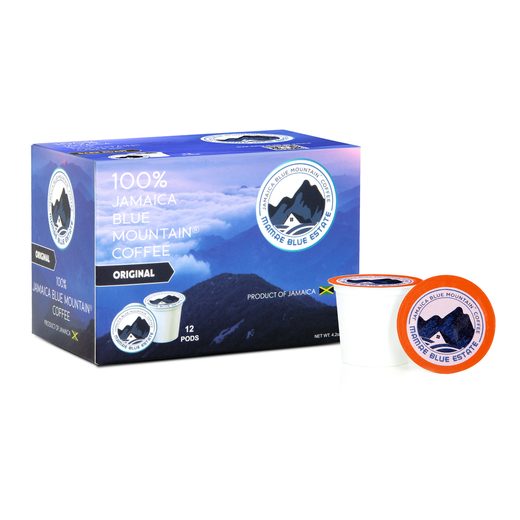
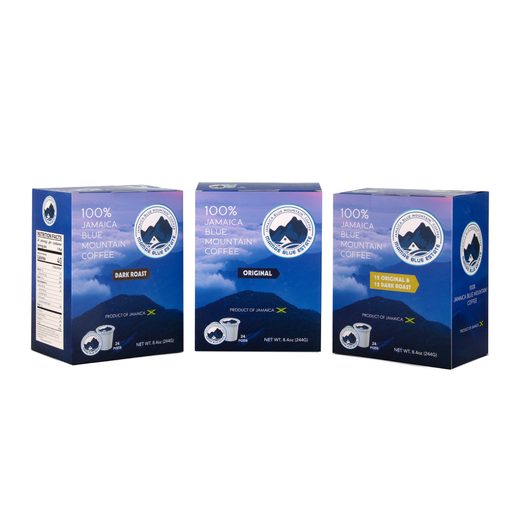
The cups differ more than the elevations do. Antigua is built around body and spice — full, velvety and chocolatey, with real presence in the cup. JBM is instead widely described by growers and importers as mild and balanced, with low bitterness and a gentler, quieter profile. Guatemala also spreads its identity across eight distinct regions with real flavor differences, from Antigua's volcanic chocolate to Huehuetenango's bright, floral cup, while Jamaica Blue Mountain is one legally bounded area growing a single variety, Typica, under rules that require anything labeled "Jamaica Blue Mountain Blend" to contain at least 30% real Blue Mountain coffee. Readers curious to taste the two side by side can start with Jamaica Blue Mountain whole bean, available alongside ground and pod formats in the shop.
Questions people ask
What makes Antigua coffee different from other Guatemalan coffee?
Is frost a risk for Antigua coffee?
What does Antigua coffee taste like?
How does Antigua coffee compare with Jamaica Blue Mountain?
Sources
Taste the benchmark
More in Origins
- Australian CoffeeAustralia grows a tiny, mechanized-harvest coffee crop in subtropical New South Wales and Queensland, almost all of it sold at home.
- Bali Coffee: Kintamani and BeyondMost of Bali's coffee comes from Kintamani, grown by subak abian cooperatives and processed as sweet, citrusy washed arabica with its own Geographical Indication.
- Bolivian CoffeeBolivia's small, high-altitude Yungas crop has shrunk dramatically since the 1990s, but Caranavi still produces some of South America's brightest specialty coffee.
- Brazilian Coffee: How the World's Largest Producer TastesBrazil's scale, mechanized farms, and dry processing produce a mild, low-acid, reliably sweet cup unlike small, high-altitude origins.
- Burundi CoffeeBurundi grows old-growth Bourbon coffee through a dense grid of smallholder washing stations centered on Kayanza and Ngozi provinces.
- Cameroon CoffeeCameroon grows a small western-highland arabica crop alongside a much larger robusta crop, both well below the country's 1990 production peak.
- Coffee in Vietnam: The Robusta GiantVietnam is the world's second-largest coffee producer, growing almost entirely robusta in the Central Highlands around Đắk Lắk province.
- Colombian Coffee: Regions, Grades and What "100% Colombian" MeansColombian coffee's regions, grades and FNC labeling explained, with a fair comparison to Jamaica Blue Mountain.