St Helena Coffee: Napoleon's Island Coffee
St Helena's Green Tipped Bourbon coffee traces to 1733 and Napoleon's exile, but today's output is tiny and verified pricing is scarce.
St Helena Coffee grows on one of the most remote inhabited islands on Earth, a speck in the South Atlantic where Napoleon Bonaparte spent his final years in exile. Its Green Tipped Bourbon plants trace back to 1733, and today's harvest is tiny, verified pricing scarce, and supply almost entirely limited to the island itself.
Where Did St Helena's Coffee Come From?
Green Tipped Bourbon coffee seeds reached St Helena in 1733, brought from Mocha, in present-day Yemen, according to a history of the island's coffee compiled by St Helena Island Info. The plants were set out across the island and, despite long stretches of neglect, adapted well to the volcanic soil and cool, misty highlands. The Bourbon variety that resulted is now closely associated with the island, in much the way a handful of other named coffee varieties are tied to a single place of origin, from Yemen itself to Jamaica's Blue Mountains.
The Napoleon Bonaparte Connection
Napoleon Bonaparte was exiled to St Helena in 1815 and died there in 1821. According to St Helena Island Info's account, Napoleon praised the island's coffee during his exile, and that association helped spark later interest in exporting it commercially. The coffee reportedly saw a brief surge of popularity in Paris after his death, as the connection to the famous exile became part of how it was marketed. As with many origin stories built around one historical figure, the praise itself is recorded secondhand rather than preserved as a direct quote, so it's worth treating as a well-established island tradition rather than a verified transcript.
A Brief 19th-Century Golden Age
St Helena coffee's reputation grew well beyond a single royal endorsement. London coffee merchants in 1839 described it as being of "very superior quality and flavor," and by 1845 it was commanding the highest price of any coffee on the London market. In 1851, coffee from the island's Bamboo Hedge estate, in Sandy Bay, won a Premiere Award at the Crystal Palace Exhibition, the same world's fair that showcased British and imperial industry to a global audience. That run of recognition marks the high point of St Helena's coffee trade.
How Much St Helena Coffee Is Grown Today?
Modern production is a small fraction of even the island's own 19th-century output. A revival effort led by David Henry restarted commercial planting in 1994, and by the late 1990s the island had roughly 18 acres of coffee under cultivation, with about 20,000 trees. Labor disputes in 2005 and 2006 set the industry back significantly, and by 2008 only about two productive acres remained, according to St Helena Island Info. Output today is well below the levels reached during the 1990s revival. Coffee has nonetheless remained a meaningful part of the island's tiny export economy: it made up about 17% of St Helena's total exports in 2019–20, alongside fishing, tourism and liqueur sales, according to Wikipedia's summary of the island's economy.
Is St Helena Coffee Available to Buy?
Coffee remains available in restaurants and shops on St Helena itself, and a small amount reaches buyers elsewhere through online retailers and occasional specialty-importer listings, according to St Helena Island Info. Given how little the island produces in any given year, availability outside St Helena is inconsistent, and a shopper searching for it should expect a small, boutique supply rather than a coffee any single retailer stocks reliably.
How Much Does St Helena Coffee Cost?
Verified pricing is hard to come by. The clearest figure available is a 2015 listing at Harrods in London, which sold St Helena coffee at £60 per 100 grams — at the time, the only place to buy it in the United Kingdom. Converted to price per pound and into current dollars, that works out to roughly $355 to $380 a pound, though a more recent US retail listing could not be verified for this page, so that figure should be read as a 2015 snapshot rather than today's going rate. Readers curious how that compares with other rarities can see the wider most expensive coffees roundup.
St Helena Coffee vs. Jamaica Blue Mountain
St Helena and Jamaica Blue Mountain share an obvious similarity: both are grown on islands, in small, clearly defined areas, and both built early reputations partly through 19th-century export trade. The two diverge sharply in scale and structure. JBM's growing area, while small, is legally defined and backed by a modern licensing and certification system through Jamaica's coffee regulator. St Helena's industry, by contrast, has shrunk to a handful of acres with no comparable certification system described in the sources checked for this page, making it one of the smallest commercially available coffee origins anywhere. Where JBM's mild, balanced reputation rests on a large, ongoing export trade, St Helena's rests mostly on a 19th-century peak it has never fully recovered. Both belong on any shortlist of the world's rare coffees, but for very different reasons.
Questions people ask
Did Napoleon really drink St Helena coffee?
Where did St Helena's coffee variety come from?
How much coffee does St Helena produce today?
How much does St Helena coffee cost?
Sources
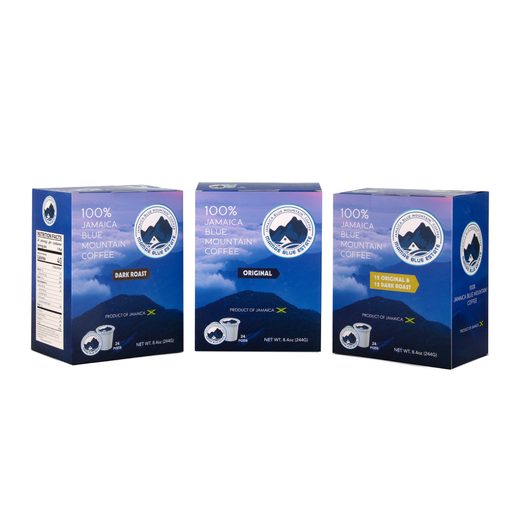
Taste the benchmark

More in Rare coffees
- The World's Most Expensive Coffees, per Pound and per Cup (2026)A sourced, per-pound and per-cup price comparison of the world's rarest coffees, from Black Ivory and auction Panama Geisha to Kona and Jamaica Blue Mountain.
- Black Ivory Coffee: The Elephant Coffee, ExplainedBlack Ivory Coffee is made in Thailand by feeding coffee cherries to rescued elephants, yielding about 500 pounds a year at a steep price.
- Geisha Coffee: Why Panama Geisha Costs So MuchGeisha is a floral Ethiopian coffee variety that became world-famous after a 2004 Panama auction win, and top lots now sell for thousands of dollars a pound.
- Jacu Bird CoffeeJacu bird coffee comes from wild Brazilian guans that eat coffee cherries naturally, unlike kopi luwak's often-caged civets.
- Kopi Luwak (Civet Coffee): Price, Taste and the Welfare ProblemKopi luwak is coffee cherries fermented inside a civet's gut, prized for rarity but dogged by documented welfare abuses, widespread fakes, and lukewarm taste reviews.