Liberica Coffee
Liberica (Coffea liberica) is a rare, giant-beaned coffee species known as kapeng barako in the Philippines, with a fruity, full-bodied cup and under 2% of world output.
Liberica is a rare coffee species best known in the Philippines, where it's called kapeng barako, and in Malaysia. Its trees and beans are the largest of any commercial coffee, its cup leans toward tropical fruit and low acidity, and it accounts for well under 2% of world coffee production.
What is Coffea liberica?
Coffea liberica is a strikingly large coffee tree, growing up to about 20 meters (65 ft) tall in the wild — tall enough that harvesters have traditionally used ladders to reach the cherries, according to Wikipedia's summary of the species. Its leaves, cherries and beans are the largest of any commercially grown coffee: individual beans run around 12 mm long, with a distinctive asymmetric shape and a hooked tip, and a 100-bean sample can weigh roughly double what the same count of arabica beans weighs.
Where does liberica coffee grow?
Liberica is native to the lowland rainforests of western and central Africa, from Liberia — the country it's named for — east to Uganda and south to Angola, per Wikipedia's summary of the species. It has since naturalized or been cultivated well beyond that range, including in Colombia, Venezuela, Sumatra, Borneo, Java and, most notably, the Philippines and Malaysia.
In the Philippines, liberica arrived in the 1740s, brought by Spanish friars to Lipa, in Batangas province, and it's still grown there and in nearby Cavite today under the local name kapeng barako. Most of the Philippine crop is sold and consumed locally rather than exported, according to Wikipedia. In Malaysia, Johor state is a major production center, with liberica also grown in Sarawak, where genetic studies have found the most pronounced hybridization between cultivated liberica and its wild relatives, according to Wikipedia's summary of the species — a sign of how much local farming history has reshaped the plant beyond its original wild stock.
Even in the Philippines, liberica remains a minority crop rather than the national coffee: about 90% of the country's total coffee output is robusta, with liberica occupying a smaller, largely regional niche centered on Batangas and Cavite, according to Wikipedia's overview of Philippine coffee production.
What does liberica coffee taste like?
Liberica's cup is generally described as full-bodied with moderate acidity and fruity, sometimes jackfruit-like aromas — a notably different profile from arabica's brighter acidity or robusta's straightforward bitterness, according to Wikipedia's summary of the species. The Specialty Coffee Association describes liberica as dominated by tropical-fruit notes, sweet, with medium body and medium acidity, and puts its caffeine level as roughly comparable to arabica's rather than markedly higher.
Roast level shifts the cup noticeably, per Wikipedia: lighter roasts emphasize the jackfruit and tropical-fruit character, medium roasts bring out caramel and chocolate notes, and darker roasts push the coffee toward more bitterness and astringency.
What share of world coffee production is liberica?
Liberica is a minor player commercially, accounting for less than 1.5% of world coffee production, according to Wikipedia's summary of the species — a small fraction even next to robusta's much larger share. The Specialty Coffee Association notes that liberica saw a brief surge of commercial significance in the late 1800s, but fell out of favor by the twentieth century as arabica and robusta cultivation expanded elsewhere; most liberica today is grown and sold as a local specialty rather than a mainstream export crop.
Why is there renewed interest in liberica coffee?
Liberica has drawn fresh attention in recent years mainly for reasons beyond flavor: it tolerates acidic peat soils where neither arabica nor robusta grow well, making it a candidate crop for parts of Indonesia's peatlands, where keeping land in agriculture rather than draining and burning it is tied to reducing carbon emissions, according to Wikipedia's summary of the species. More broadly, the Specialty Coffee Association notes that liberica withstands higher temperatures than arabica and shows useful resistance to some common coffee pests and diseases — qualities that matter more each year as growers plan for a warmer climate, a pressure also discussed on the excelsa coffee page for liberica's closest commercial relative.
How does liberica compare with Jamaica Blue Mountain?
| Liberica (Coffea liberica) | Jamaica Blue Mountain (Arabica Typica) | |
|---|---|---|
| Tree size | Up to about 20 m (65 ft); traditionally harvested with ladders | Much smaller, hand-picked arabica tree |
| Growing conditions | Hot, humid lowlands; tolerant of poor, acidic soils | High elevation, cooler temperatures, a defined estate area |
| Flavor | Full-bodied, fruity, jackfruit-like, moderate acidity | Widely described as mild and balanced, with low bitterness |
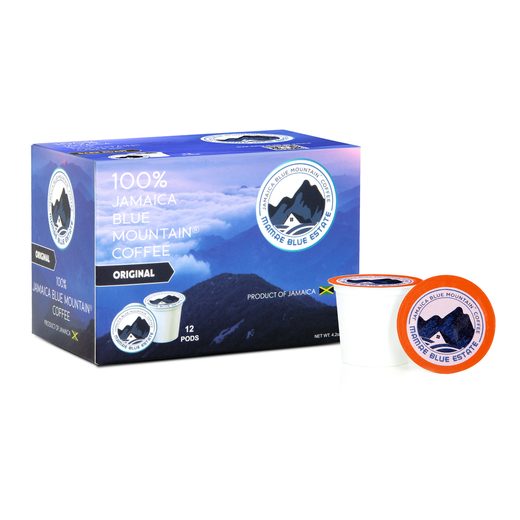
Liberica and Jamaica Blue Mountain sit at opposite ends of what coffee can be. JBM comes from a small, high-elevation Typica arabica planting in a legally defined part of Jamaica's Blue Mountains and is widely described as mild and balanced; liberica comes from a massive, heat-tolerant lowland tree and produces a fuller-bodied, fruitier, more assertive cup. Readers curious about that milder, more restrained style can start with Mamre Blue's Jamaica Blue Mountain ground coffee.
Questions people ask
What does liberica coffee taste like?
Where is liberica coffee grown?
What is kapeng barako?
Is liberica coffee rare?
Sources
Taste the benchmark
More in Varieties
- Maragogype: The Elephant BeanMaragogype is a natural Typica mutation discovered in Brazil in 1870, nicknamed the elephant bean for producing some of arabica coffee's largest beans.
- Mundo Novo CoffeeMundo Novo is a natural Typica-Bourbon cross discovered in Brazil and released in 1952, valued for its vigor, high yield and role in Catuaí's creation.
- Pacamara CoffeePacamara is a large-beaned coffee variety bred in El Salvador in 1958 by crossing Pacas and Maragogipe, now prized in specialty markets and Cup of Excellence.
- Pink Bourbon CoffeePink Bourbon is a pink-cherried variety from Colombia's Huila department whose genetic identity is still debated, prized by specialty buyers for its distinctive cup.
- Robusta Coffee: What It Is and Where It GrowsRobusta (Coffea canephora) is the higher-caffeine, hardier coffee species behind instant coffee and espresso blends, grown mainly in Vietnam, Brazil and Uganda.
- Sidra CoffeeSidra is a fruit-forward Ecuadorian coffee variety with a disputed genetic origin and multiple World Barista Championship wins to its name.
- SL28 and SL34: Kenya's Famous VarietiesSL28 and SL34 are two arabica varieties selected in 1930s Kenya by Scott Agricultural Laboratories that still define much of the country's celebrated coffee flavor.
- Stenophylla: The Rediscovered Coffee SpeciesStenophylla is a once-abandoned West African coffee species rediscovered in Sierra Leone, with arabica-like flavor and notable heat tolerance, per 2021 research.