French Press vs Pour-Over: Taste, Body, Health and Method
A French press steeps coffee and strains it through metal; a pour-over drips it through paper. That one difference changes body, clarity, cleanup and even how much cafestol reaches the cup. This guide compares the two step by step.
French press vs pour-over is one of the most common choices for anyone brewing coffee by hand. Both are cheap, need no electricity beyond a kettle, and make excellent coffee. They differ in one basic way: a French press steeps all the coffee in all the water and strains it through a metal mesh, while a pour-over lets water flow through a bed of coffee and out through a filter, usually paper. That difference changes the body and clarity of the cup, how much attention the brew needs, and, according to recent research, how much of the cholesterol-raising compound cafestol ends up in your mug. This guide compares them on the facts, using the National Coffee Association's brewing guides and published studies.
French press vs pour-over at a glance
| French press | Pour-over | |
|---|---|---|
| How it brews | Immersion: grounds steep in all the water | Percolation: water flows through the grounds |
| Filter | Metal mesh screen | Usually paper; metal and cloth also exist |
| Grind (NCA) | Coarse, like rock salt | Medium to start, then adjust |
| Ratio (NCA) | 1:10 to 1:16 | 1:13 to 1:16 |
| Water temperature (NCA) | About 93 ± 3 °C | About 93 ± 3 °C |
| Contact time (NCA) | About 4 minutes | 2 to 4 minutes |
| Typical cup | Heavier body, some sediment, more oils | Lighter body, cleaner and clearer |
| Cafestol (2025 study, see below) | Moderate | Low with a paper filter |
| Skill needed | Low: pour, wait, press | Moderate: pouring speed and pattern matter |
How each method works
French press
The National Coffee Association's French press method is simple: heat water to about 93 ± 3 °C (let boiled water rest briefly), add coarsely ground coffee to the carafe, pour in the water, stir the crust after about a minute, put the lid on with the plunger up, and steep for about three more minutes before pressing slowly. The NCA advises serving straight away or decanting, because coffee left sitting on the grounds keeps extracting and turns bitter.
Pour-over
A pour-over brewer is a cone or flat-bottomed dripper that holds a filter over a cup or carafe. The NCA's method: rinse the paper filter with hot water and discard the rinse, add medium-ground coffee and level the bed, pour about twice the coffee's weight in water to "bloom" for 30 to 45 seconds, then add the rest in a slow, steady spiral from the center outward so the total contact time is 2 to 4 minutes. The NCA notes that flat-bottom drippers give a slower, more even flow that is easier for beginners, while cones with 60-degree walls flow faster and suit more experienced brewers.
Taste and body
The filter is the biggest reason the two cups taste different. A metal mesh lets through coffee oils and very fine particles, so French press coffee has a heavier, rounder body and a little sediment at the bottom of the cup. A paper filter holds back most of the oils and fines, so pour-over coffee is lighter and cleaner, and flavors tend to read as more separate and distinct. The NCA describes the same trade-off between filter materials: paper gives a cleaner, lighter taste, metal mesh gives more oil, sediment and body, and cloth sits in between.
Neither is "better" in general. Drinkers who like a rich, heavy cup, or who add milk, often prefer the press. Drinkers who want to taste the differences between origins, or a delicate coffee's aroma and acidity, often prefer pour-over (see coffee acidity for what that word means in the cup).
Cafestol, cholesterol and filtering
Coffee beans contain oily compounds called diterpenes, mainly cafestol and kahweol, which are known to raise LDL cholesterol. How much reaches the cup depends on the filter. A 2025 study by Swedish researchers from Uppsala University and Chalmers University of Technology, published in Nutrition, Metabolism and Cardiovascular Diseases, measured diterpenes in coffee from 14 workplace machines and from several home methods. As reported by ScienceAlert, paper-filtered drip coffee had a median of about 11.5 mg of cafestol per liter, French press coffee came in under 90 mg/L, and unfiltered boiled coffee averaged just under 940 mg/L. Chalmers' own summary says drip-filter coffee filters out almost all of these substances, and quotes the researchers' advice that heavy daily coffee drinkers should prefer drip-filter or other well-filtered coffee.
Two cautions. The researchers say a controlled study would be needed to measure the exact effect on LDL cholesterol, and the samples were small. And this is general information, not medical advice: if you have been told to watch your cholesterol, ask your doctor whether your brewing method matters for you. If it does, a paper-filtered pour-over is the simpler choice than a press.
Which is easier, faster and cheaper?
- Ease: the French press is more forgiving. Once the grind and ratio are set, timing is the only variable. Pour-over results depend on pouring speed, pattern and grind, so it takes a few tries to get consistent.
- Time: both take about four minutes of brewing plus heating water. A pour-over needs you to stand and pour; a press leaves you free while it steeps.
- Batch size: presses come in sizes that brew several cups at once. Most single-cup drippers make one or two cups, though larger cone brewers with carafes exist.
- Running cost: a press needs no filters. Paper pour-over needs a filter each brew; metal and cloth pour-over filters are reusable (the NCA suggests boiling cloth filters every 6 to 8 weeks).
- Cleanup: pour-over is easier, since the used filter and grounds lift out together. Press grounds have to be scooped or rinsed out of the carafe and screen.
How to choose between them
- Decide on body or clarity. Want a heavy, rich cup? Choose the press. Want a clean cup that shows a coffee's character? Choose pour-over.
- Consider filtering. If you drink several cups a day and want the lowest cafestol, use a paper filter.
- Think about attention. If you want to set it and walk away, the press is easier; if you enjoy the ritual, pour-over rewards practice.
- Match the grind you have. If you only have a blade grinder, pour-over with paper hides uneven grinds better than a press, whose screen lets fine dust through (see the coffee grind size chart).
- Try both with the same coffee. Brew the same beans both ways on the same day and compare. It is the quickest way to learn which you prefer.
French press or pour-over for Jamaica Blue Mountain?
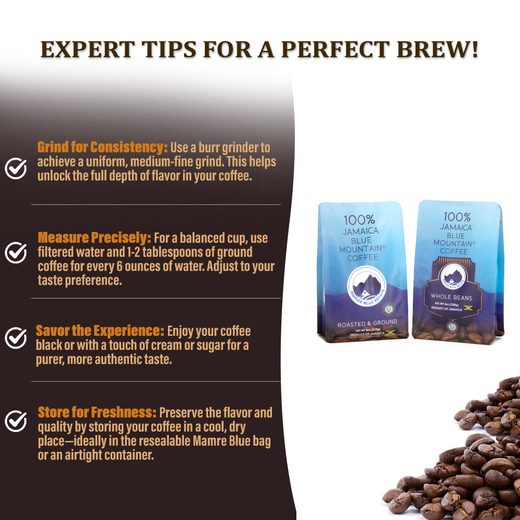
Jamaica Blue Mountain is prized for being mild, smooth and low in bitterness rather than bold (see what Blue Mountain coffee tastes like). A paper pour-over shows that clarity best, which is why our Blue Mountain brewing guide calls it a good way to taste the coffee. A French press works well too if you like more body: keep the grind coarse, stay near the middle of the ratio range (about 1:15), and pour the coffee off the grounds as soon as you press, because over-extraction adds the bitterness a mild coffee is bought to avoid. Whichever you choose, freshly ground whole beans make more difference than the brewer (see how to store coffee beans).
Disclosure: this site is published by Mamre Blue Coffee, a Jamaica Blue Mountain estate (see about us), so we rely on official and independent sources for the facts on this page.
Questions people ask
Is French press coffee stronger than pour-over?
Is pour-over coffee healthier than French press?
What grind do I need for French press and pour-over?
Which is easier for beginners?
Can I use the same coffee for both?
Sources
- French Press Coffee (National Coffee Association USA, About Coffee)
- Pour-Over Coffee (National Coffee Association USA, About Coffee)
- Workplace coffee might increase your cholesterol levels (Chalmers University of Technology, March 31 2025)
- How You Make Your Coffee Could Affect Your Cholesterol Levels (ScienceAlert, March 26 2025, on Orrje et al., Nutrition, Metabolism and Cardiovascular Diseases 2025)
- Coffee preparation (Wikipedia)
Taste the benchmark


More in Coffee knowledge
- History of Jamaica Blue Mountain Coffee, from 1728 to JACRACoffee reached Jamaica in the 1720s; the Blue Mountain name became a regulated, certified product only in the 20th century, through the 1944 clearing house, the 1950 Coffee Industry Board and, since 2017, JACRA.
- How to Brew Jamaica Blue Mountain Coffee at HomeBrew Blue Mountain like any good washed arabica, but gently: fresh whole beans, about 1 to 2 tablespoons per 6 ounces of water, water just off the boil, and a grind matched to the method so that its mild, low-bitterness character is not over-extracted.
- How to Cup Coffee: A Step-by-Step Guide to Coffee CuppingCupping is how coffee is bought, graded and scored around the world. It looks like a ritual, but it is a simple, repeatable recipe that anyone can follow at home with a scale, a kettle and two spoons.
- How to Spot Fake Jamaica Blue Mountain CoffeeJamaica's regulators have chased counterfeit Blue Mountain coffee for over a decade; buyers can screen out most of it by reading the label carefully and asking where the coffee came from.
- How to Store Coffee Beans So They Stay FreshRoasted coffee does not go off like milk, but it does go stale. Air, moisture, heat and light are the enemies. Here is how to store whole beans and ground coffee, and how long each keeps.
- Hurricane Melissa and Jamaica Blue Mountain CoffeeMelissa hit Jamaica in October 2025 at the start of the coffee harvest. Official reports put early damage to the coffee industry at about 35%, and JACRA has since led a replanting and input programme.
- Italian Coffee CultureItalian coffee culture runs on the standing espresso bar and the stovetop moka pot, backed by more than a century of machine history and widely followed customs.
- JACRA: How Jamaica Certifies Blue Mountain CoffeeJACRA replaced the Coffee Industry Board in 2017 and now registers growers, licenses dealers and coffee works, certifies quality and holds export coffee in its own custody until it ships.